
Stress tends to sit in the body as much as in the mind. Shoulders rise toward the ears, the jaw sets, breathing turns shallow and quick, and the day’s worries keep running even when you sit down. Tai chi for stress relief works on that physical side. Taiji Quan asks you to move slowly, keep your knees soft, and pay attention to one thing at a time, and that combination often leaves people feeling steadier than when they began.
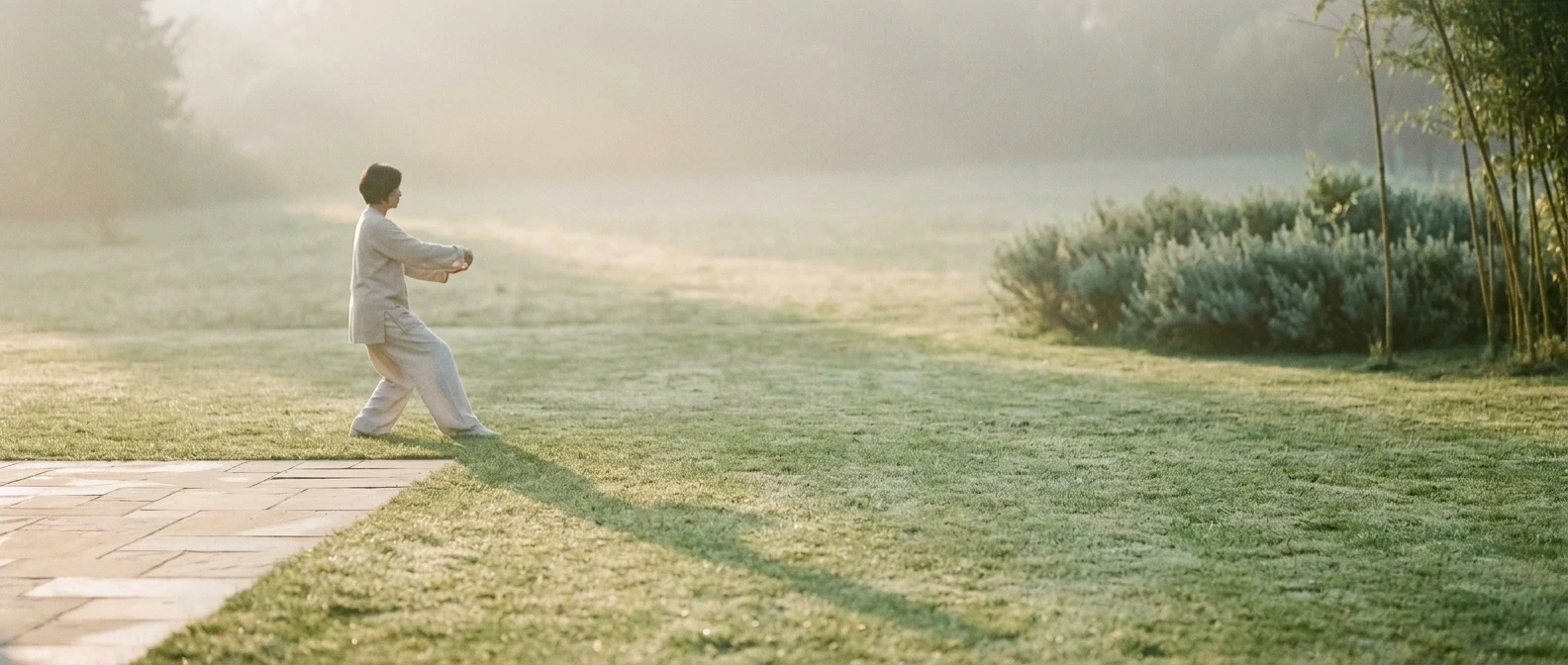
This article covers why that might happen, what the research supports and what it leaves open, and a ten-minute sequence you can do standing or seated. It is written for beginners, including anyone with stiff or achy joints.
Why slow movement can settle a busy mind (and what Taiji Quan cannot promise)
A stressed mind usually runs fast: several tasks at once, a jumpy breath, attention pulled in every direction. Taiji Quan gives that restlessness a different job. Each movement is slow enough that you can feel your feet, your weight and your breath while it happens, and there is only one thing to follow at a time.
That is the basic idea behind its calming reputation. When you have to coordinate your arms, your waist and your weight at a gentle pace, there is little room left for rehearsing tomorrow’s meeting. Many people notice their breathing lengthen and their shoulders drop without being told to.
It helps to be clear about the limits. Taiji Quan is a gentle exercise and attention practice. It is not a treatment for anxiety, depression, high blood pressure or any other condition, and it will not remove the causes of your stress. A difficult job, a caring duty or a worrying diagnosis will still be there afterwards. What a practice can offer is a steadier way of meeting them, and a daily few minutes where your body gets to put something down.
What the research says about Taiji Quan, stress and cortisol, and where it is still unclear
Researchers have looked at whether tai chi affects mood and stress, and the overall picture is encouraging but cautious.
A 2010 systematic review and meta-analysis by Wang and colleagues, published in BMC Complementary and Alternative Medicine under the title “Tai Chi on psychological well-being,” pooled studies on outcomes such as anxiety, depression, stress and mood. It reported that the studies generally pointed toward benefit. The authors also pointed out that many of the trials were limited in design, so they called for better-quality research before firm conclusions.
A later review, “The effects of tai chi on depression, anxiety, and psychological well-being: a systematic review and meta-analysis,” by Wang and colleagues in the International Journal of Behavioral Medicine (2014), looked at similar questions with a larger body of studies. It also found signs of benefit and again noted that study quality varied.
The US National Center for Complementary and Integrative Health (NCCIH) offers a plain-language overview in its guide to tai chi and Qigong. It describes both as generally safe for most people when practised with sensible care, and it treats the evidence for mood and well-being as promising rather than settled.
Cortisol is where the picture is least clear. It is often called the stress hormone, and many articles claim that Taiji Quan lowers it. The reviews above mostly measured mood and stress through questionnaires, not hormone levels, so they cannot confirm that claim. Treat any article that states it as fact, this one included if it ever did, with caution.
Two other uncertainties are worth knowing:
- Comparison groups. Some studies compare tai chi with doing nothing, which makes any form of gentle activity or social contact look helpful. It is hard to separate what is special about Taiji Quan from the benefits of moving gently in a group.
- Style and dose. Studies use different styles, session lengths and durations, so there is no research-backed figure for how many minutes a day will help.
The honest summary is that Taiji Quan appears to be a reasonable, low-risk way to support your mood, and that the strongest claims are not yet proven. That is enough reason to try it and not enough reason to expect miracles.
Three habits of Taiji that do the calming
Whatever form or style you eventually follow, three habits carry most of the calming quality. You can practise them in a chair, at a counter or in a queue.
Soft breath
Breathe through your nose if that is comfortable, and let the breath be unhurried. Do not force a deep breath. Let the exhale run a little longer than the inhale, and let your belly soften as you breathe out. If counting helps, try in for three and out for four, and drop the count if it makes you tense.
For more on breathing as a practice in its own right, see the site’s guide on how to begin a daily Qigong practice.
Sinking weight
Taiji Quan teaches you to let your weight settle down through the legs into the floor instead of holding yourself up with your shoulders and neck. Soften your knees slightly, so they are not locked, and imagine your weight dropping into the soles of your feet. Notice what your shoulders do when you stop bracing. Often they fall a centimetre or two without any effort.
Steady attention
Pick one place to keep your attention, such as the feeling of weight moving from one foot to the other, or the warmth in your palms. Your mind will wander. When you notice, bring it back without scolding yourself. The returning is the practice, and each return is a small rehearsal of letting go of a worry.
A ten-minute daily sequence for beginners, with seated options
Find a clear space about two arm-spans wide. Wear shoes or socks with grip, or go barefoot on a non-slip floor. Stand beside a sturdy chair or a wall so you can steady yourself if needed. Move at about half the speed that feels natural, and stop anything that causes sharp pain, dizziness or chest discomfort. If you have a health condition, or concerns about balance, ask your doctor or physiotherapist before starting.
1. Arrive (1 minute)
Stand with your feet about shoulder-width apart, toes pointing forward. Bend your knees a little, as if about to sit on a high stool. Let your arms hang. Breathe slowly and feel your feet on the floor.
Seated: Sit toward the front of the chair with both feet flat and hip-width apart. Rest your hands on your thighs and let your back be tall but not stiff.
2. Shifting weight side to side (2 minutes)
Slowly move your weight onto your right foot, then back through the centre, then onto your left foot. Keep your knees soft and your upper body quiet. Let the breath follow the movement: breathe out as you shift, breathe in as you pass through the middle.
Seated: Press gently into one foot and then the other, letting your hips rock a small amount. The movement can be tiny.
3. Raising and lowering the arms (2 minutes)
Breathe in as you lift both arms forward to about shoulder height, palms facing down, wrists loose. Breathe out as you bend your knees slightly and let the hands float down to hip level. Repeat slowly. The arms should feel carried by the breath, not lifted by the shoulders.
Seated: Do the same with your arms, and keep the lift lower if your shoulders feel tight. Stopping at chest height is perfectly good.
4. Turning the waist (2 minutes)
Let your arms hang loosely. Turn your waist gently to the right, allowing your arms to swing softly around your body, then turn to the left. Your hips and knees face mostly forward. Keep the turn small, and let your eyes follow the direction of the turn.
Seated: Turn your upper body slightly from side to side with your hands resting on your thighs or lightly crossed over your belly. Keep both sitting bones on the chair.
5. Holding the ball (2 minutes)
Raise your hands as if holding a large, light ball at chest height, with space under your arms. Stand still with soft knees and breathe slowly. Let your shoulders and elbows hang heavy. You may feel warmth or tingling in your hands, which is common and not something to chase.
Seated: Hold the same shape while sitting tall. Rest your elbows against your sides if your shoulders tire.
6. Close (1 minute)
Lower your hands and rest them on your lower belly, one over the other. Stand or sit quietly and breathe. Notice whether anything has changed, without judging it. Then let your arms drop and take one natural step or stretch before you go on with your day.
If your knees or hips complain during the standing version, shorten the time and use the seated version. The site’s piece on how Taiji looks after your knees, hips and shoulders goes into joint care in more detail.
Fitting it into a stressful day: morning, midday reset and evening wind-down
Ten minutes in one block works well, but it can also be split. What matters more than length is doing it most days.
- Morning (3 to 5 minutes). Do steps 1, 2 and 3 before looking at your phone. This sets your pace for the day and is easy to attach to something you already do, such as waiting for the kettle.
- Midday reset (2 to 3 minutes). When your shoulders creep up or your thoughts are racing, stand or sit and do the weight shift with slow breathing. A restroom, a corridor or a spot beside your desk is enough. No one needs to know.
- Evening wind-down (5 minutes). Do the waist turning, then holding the ball, then the closing. Keep the lights low if you like. The aim is to let the day’s tension settle, not to finish a routine. If you practise Qigong in the evening as well, how to relax after Qigong practice offers ideas for ending a session well.
Missing a day is normal. Start again the next day without making up for it, because a short practice repeated gently does more than an occasional long one that feels like a chore.
When the stress is bigger than a practice can hold
Taiji Quan can sit alongside other care, but it cannot replace it. Please speak to a doctor, counsellor or other qualified professional if:
- you feel low, anxious or on edge most days for more than a couple of weeks
- stress is affecting your sleep, appetite or ability to work or care for others
- you have panic attacks, chest pain or unexplained physical symptoms
- you have thoughts of harming yourself
If you are in crisis or worried about your safety, contact your local emergency number or a crisis line in your country right away. You do not need to wait until things feel bad enough.
Many people find that a gentle practice, good support and sometimes professional treatment work together better than any one of them alone. Mentioning your Taiji Quan practice to a health professional is welcome, and they can tell you whether any movements need adjusting for your situation.
One thing to try tomorrow
Tomorrow, stand for three minutes with your feet shoulder-width apart and your knees soft. Let your weight sink into your feet, and breathe slowly while you shift your weight gently from side to side. Notice your shoulders and your jaw, and let them soften if they will.
If you would like a gentle route into the rest of the site, from Taiji Quan basics to Qigong and mindful eating, start here.