
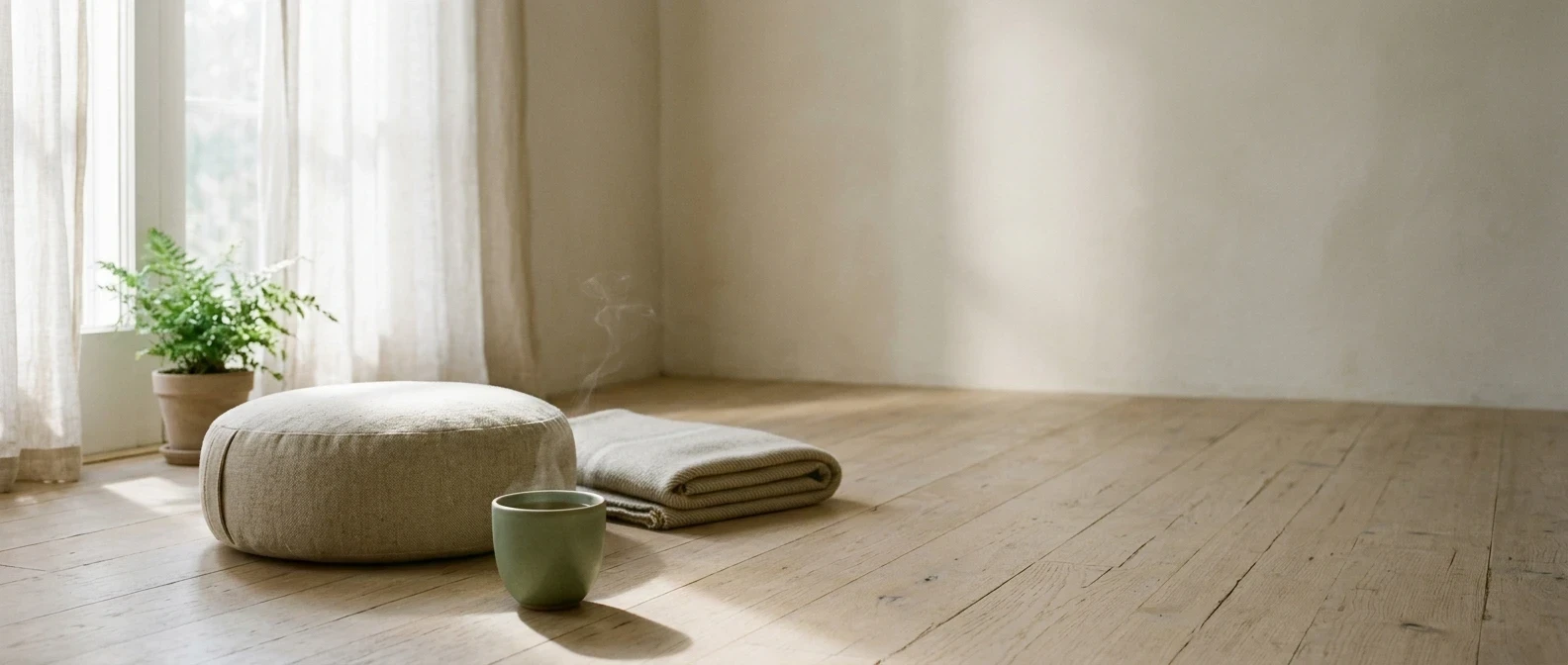
Many beginners with stiff or achy joints carry a quiet worry: if I skip a day, I will lose what I have gained. The worry is understandable. Most of us were taught that progress comes from doing more, and a gentle practice like Qigong gets treated the same way. Rest then looks like the opposite of practice.
Qigong is built around alternating effort and release, and the movements themselves are slow and soft so that the body is not pushed. Rest belongs in the practice in three places: the pause at the end of a session, the days between sessions, and the habit of listening that tells you when to stop. This article takes each in turn, with a simple weekly rhythm at the end.
Why resting can feel like falling behind
A rest day can feel like a lapse when you are new. You have no routine yet, so each skipped session seems to threaten the whole thing. If your joints are stiff, you may also feel that you are already behind other people your age.
Qigong gives you a different measure. Success is not counted in minutes or repetitions. It is whether your practice is something you can keep returning to for months and years. A routine that leaves you sore, drained or dreading the next session will not last, however disciplined it looks on a calendar.
Rest in this sense is not time away from Qigong. It is part of how the practice is built, in the same way that a pause between two breaths is part of breathing.
The closing pause: the few minutes after practice
Many Qigong teachers end a session by standing or sitting quietly for a few minutes. The movement has stopped, but you stay with the breath and the body for a little longer before you return to the day. This is the shortest form of rest in the practice, and the easiest to skip because the “real” exercise seems to be over.
A simple way to do it:
- Finish your last movement and let your hands settle at your sides, or rest them on your lower belly.
- Stand with your knees softly unlocked, or sit with your back supported.
- Let your eyes go soft, looking at nothing in particular, or close them if that feels comfortable.
- Breathe without steering the breath. Let it find its own pace.
- Stay for two to five minutes, then open your eyes and move on slowly.
Rushing from the last movement to the next task gives you no chance to notice how you feel. The pause is when you can register what changed: whether your shoulders dropped, whether a stiff hip feels looser or just different, whether you are more tired than you expected. That information is useful for deciding what to do tomorrow.
If sitting still feels uncomfortable or restless, that is common and has its own explanation. It is covered in why stillness can feel difficult in Qigong practice. For now, a shorter pause is fine. One minute of quiet is better than none.
How often to practise when your joints are stiff
There is no single correct frequency, and this article cannot tell you one for your body. What you can do is start lower than you think you need to and add more only when the current amount feels easy.
For many beginners, three or four short sessions a week is a reasonable place to begin, with a day off between some of them. Short means ten to twenty minutes. If you have a medical condition affecting your joints, or you are recovering from an injury, talk to your doctor or physiotherapist before you start and ask how much movement suits you.
The relationship between movement and rest matters for stiff joints. The Arthritis Foundation, for example, advises people with arthritis to balance activity with rest and to pay attention to how their joints respond, rather than pushing through pain. That is general guidance, not a prescription for Qigong, but it fits the way the practice is meant to work.
What a rest day can look like
A rest day does not have to mean no movement at all. It means no formal session and no effort to improve. Some options:
- Take a short walk at an easy pace, with no target distance.
- Do one or two movements you like, slowly, for a minute or two, without following a full sequence.
- Sit by a window for five minutes and follow your breath.
- Do nothing planned, and pay attention to how your body feels getting up from a chair.
Choose the one that suits your energy that day. Part of resting well is accepting that the answer changes from one day to the next.
Telling tired-in-a-good-way from too much
After a Qigong session you may feel pleasantly heavy, warm, or calm, perhaps a little sleepy. That is a different state from being worn out or sore, and learning to tell them apart is the third kind of rest: the listening that decides when to stop.
Signs that you are tired in a good way:
- Your breathing is easy and slower than before you started.
- Muscles feel used but not strained.
- You feel like sitting down, and when you do, you feel settled.
- By the next day you feel ready for another gentle session, or at least not against the idea.
Signs that your body is asking for a pause:
- Joint pain that is sharp, or that stays or grows worse after you stop.
- Stiffness that is clearly worse the next morning than before you began.
- Shaky legs, light-headedness or breathlessness during practice.
- Dreading the session, or feeling irritable and flat afterwards.
- Cutting your movements short because you want it to be over.
If you notice any of these, shorten the next session, make the movements smaller, or take a rest day. Pain that is sharp, new or persistent is a reason to speak to a doctor rather than to adjust your Qigong. The practice is not a substitute for medical advice.
Stopping early on a day that is not going well does not mean you failed that session. It is the listening working as intended.
Rest that is not doing nothing
Rest has a few forms beyond the closing pause and the days off. Each does something different.
Lying down. Lying on your back with your knees bent and feet flat on the floor, or with a cushion under your knees, takes weight off your joints and lets the muscles around them let go. Five to ten minutes is plenty. Let your arms rest at your sides and follow your breath.
Sitting quietly. Sitting without a task, a screen or a book gives your attention somewhere to rest. You do not need to do anything with your mind. If thoughts come, let them pass and return to feeling your weight in the chair.
Sleeping well. Sleep is where most of the body’s recovery happens, and it is the form of rest that nothing else replaces. The US Centers for Disease Control and Prevention gives seven or more hours a night as the recommended amount for adults. If you wake often, wake stiff, or cannot fall asleep, mention it to your doctor, because that is outside what Qigong can promise to fix.
A gentle session earlier in the day, finished with the closing pause, suits some people as part of an evening wind-down. Others find movement late in the day stimulating. Notice which group you are in.
What rest can and cannot do
Rest supports practice. It gives the body time between sessions, makes it easier to keep going, and gives you room to notice how you respond to the movements. For many people that is enough reason to build it in.
Rest cannot cure stiff joints, treat arthritis, or replace care from a doctor. Qigong does not promise a medical result either, and nothing here should be read as one. Research on Qigong and similar practices exists, but findings vary, and the quality of studies varies too. If you want to read for yourself, the US National Center for Complementary and Integrative Health (NCCIH) publishes plain-language summaries of the evidence on Tai Chi and Qigong, and it is a sound place to start.
Keep your expectations modest and watch your own experience. Over weeks, you may notice that you move more easily on some mornings, or that you feel calmer after practising. Those observations are yours, and worth more to you than a claim from any article.
If you wonder what is happening during the weeks when everything feels the same, when nothing seems to be happening in Qigong speaks to that directly.
A gentle weekly rhythm to start with
Here is one pattern you can adjust. It is a starting point, not a rule.
- Monday: a short session of ten to fifteen minutes, with a three-minute closing pause.
- Tuesday: rest day. A walk or quiet sitting if you feel like it.
- Wednesday: a short session, the same length or shorter.
- Thursday: rest day.
- Friday: a short session, with a closing pause.
- Saturday: optional. A few favourite movements, or a rest day.
- Sunday: rest day. Lie down for ten minutes at some point.
For the sessions themselves, the ten-minute Qigong sequence for stiff mornings is a gentle option that starts before you leave bed. Ten minutes is enough, and you can end it with the closing pause described above.
After two or three weeks, review the pattern. If you feel good and want more, add a session. If you feel tired or sore, take one away. The rhythm should fit your body, which will change over time.
One thing to try
After your next Qigong session, stand or sit quietly for three minutes with your eyes soft and your breath unhurried. When the three minutes are over, write one line about what you notice. It can be about your breath, your shoulders, your mood or your energy. A few weeks of these lines will show you more about how you respond to practice and rest than any schedule could.