
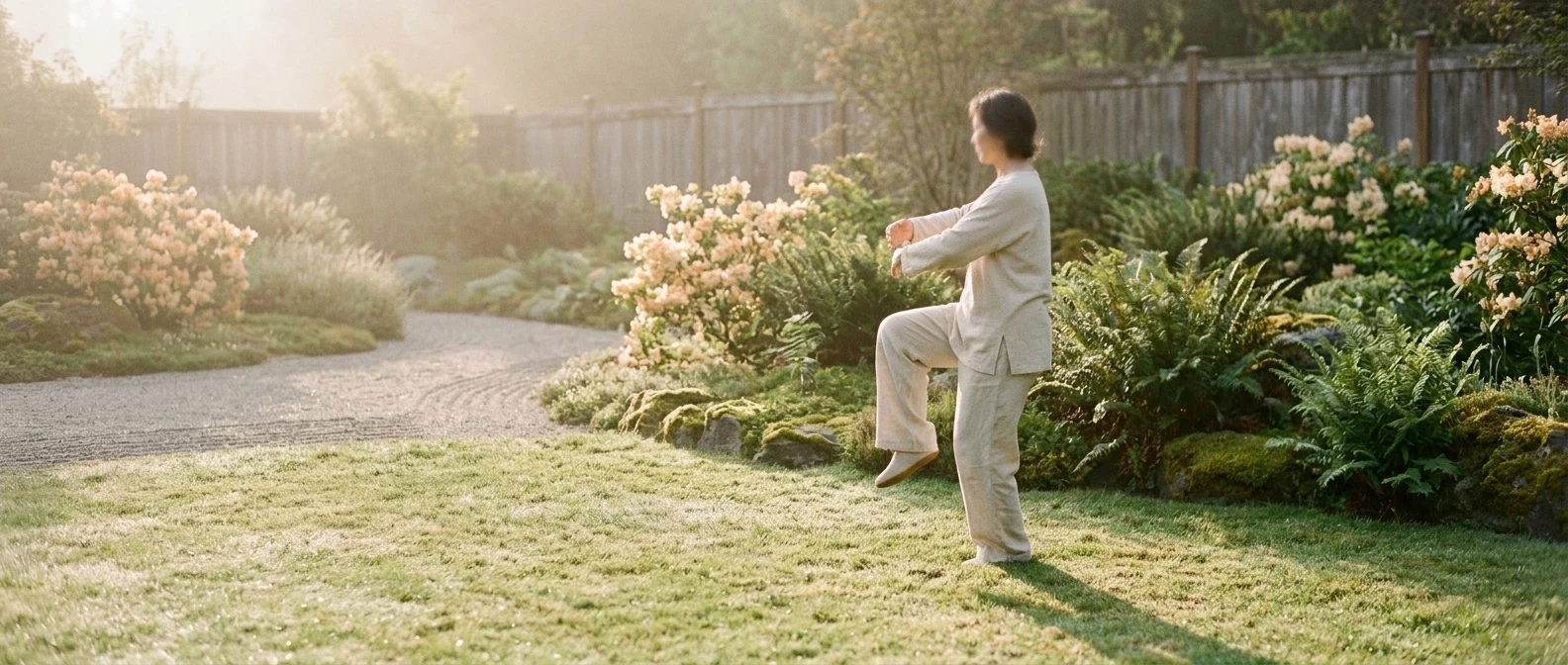
Most people notice balance in the moment it wobbles: a step off a kerb that lands harder than expected, or a hand that reaches for the wall while pulling on a sock. Balance rarely declines in one go. Leg strength, ankle movement, vision, sensation in the feet and reaction speed can each shift a little over the years, and some medications cause dizziness. Together those small changes make standing and stepping less automatic than they used to be.
Taiji Quan is one gentle way to practise the skills that keep you steady. This article covers what Taiji trains, how to set up a safe space at home, and a short routine you can do with a hand resting on a kitchen counter. It also covers what Taiji cannot promise, which matters just as much.
Why balance quietly slips in midlife, and what the research does and does not show
The CDC lists lower body weakness, vision problems, foot pain or unsuitable footwear, and certain medications among the common risk factors for falls in older adults. It also recommends exercise that improves balance and leg strength, and names Tai Chi as one example. Its guidance on talking to your doctor about medications, vision and home hazards deserves as much attention as the exercise advice.
The research on exercise and falls is more cautious than the headlines. The Cochrane review of exercise for preventing falls in older people living in the community (Sherrington and colleagues, last updated in 2019) concluded that exercise programmes, especially those with a strong balance component, reduce the number of falls. For Tai Chi specifically, the review found it may reduce falls but rated the certainty of that evidence as low. Low certainty means further studies could change the picture, so treat the finding as encouraging rather than settled.
Before you quote any figure from these sources, read the current versions on the CDC and Cochrane websites, since reviews are updated. For this article the plain summary is enough: practising balance helps, Taiji is a reasonable way to do it, and it is not a guarantee.
If your main concern is stiff or achy joints, the piece on how Taiji looks after your knees, hips and shoulders covers that side. This one is about steadiness.
The three things Taiji actually trains
Taiji forms look like one flowing movement, but they are built from a few repeated skills. Three of them bear directly on balance, and each can be practised on its own.
Weight shifting
In Taiji you move your weight completely from one leg to the other before you do anything else. One leg is full (carrying the weight) and the other is empty (free to move). In daily life most of us shift weight in a rush, carrying shopping or turning to answer a call. Practising the shift slowly teaches your legs and ankles to accept your full weight without a lurch.
Slow stepping
A Taiji step is made in stages: shift the weight, lift the empty foot, place the heel, then roll the weight forward onto the sole. Because the step is slow, you cannot rely on momentum to carry you through it. Your standing leg has to do the work while the other foot travels, which is the same demand a stumble on uneven ground makes of you in an instant.
A rooted stance
Rooting means standing with your feet about hip-width apart, knees soft, weight evenly spread across both feet, and your body upright without stiffness. The word comes from the feeling of your weight settling down into the ground through your legs, so that you are not holding yourself up with tense shoulders. A rooted stance is where weight shifts and steps begin and end, and it is a skill in its own right.
Before you start: a safe space, footwear and when to check with your doctor
Set up the room before you move, because most of the safety in this practice comes from the setup.
- Use a sturdy support. A kitchen counter at about hip height works well. It should not slide, tip or wobble when you lean a hand on it.
- Clear the floor. Move rugs, cables and pet bowls out of the area. Leave about two arm-lengths of clear floor in the direction you will step.
- Choose a non-slip surface. Bare feet on a dry, non-slip floor are fine for many people. Socks on tile or polished wood are a common cause of slips, so avoid them.
- Think about footwear. Flat shoes with a thin, grippy sole and a snug fit let you feel the ground. Thick cushioned soles and loose slippers make that harder. The article on what to wear for Taiji practice goes into more detail.
- Light the room well and keep your phone within reach.
Check with your doctor or physiotherapist first if you have had a recent fall, regular dizziness or fainting, a diagnosed balance or inner ear condition, osteoporosis, a joint replacement, neuropathy in your feet, or if a medication makes you light-headed. They can tell you whether to adjust anything, or whether a supervised programme would suit you better.
Stop if you feel dizzy, short of breath, or notice any sharp pain. Sit down and rest. Practice should feel like gentle effort, never strain.
A counter-supported practice: weight shifts, heel-toe steps and a slow turn
Stand beside the counter with the hand nearest to it resting lightly on the surface. Rest the hand without gripping, so the counter is there in case you need it and not holding you up. Do each exercise on its own for a minute or two. The whole routine takes about five minutes.
1. Find your stance
Stand with your feet hip-width apart and parallel. Soften your knees slightly, as if you had just begun to sit. Let your arms hang, and imagine the crown of your head lifted gently by a thread. Notice whether your weight leans toward your toes, your heels, or one side, and let it settle evenly.
2. Weight shifts
Slowly move your weight onto your right foot until the left foot feels light. Pause for a moment. Then move slowly back through the centre and across to the left foot. The movement should come from your legs, with your upper body staying upright and relaxed.
Do ten shifts in each direction at first. If you want an extra challenge once this feels easy, let the hand on the counter float an inch above it for the length of one shift.
3. Heel-toe steps
Shift your weight onto your right foot. Lift your left foot slightly and place the heel a short step in front, with the toes lifted. Then slowly roll the left foot flat while your weight moves forward onto it. The right foot becomes the empty one. Pause, then shift back and withdraw the left foot.
Keep the step small. Do five steps with each leg, moving along the counter if you have space or stepping forward and back in place.
4. A slow turn
Shift your weight onto your right foot. Pivot the left toes outward a little while keeping the heel on the floor, then shift weight onto that foot and let your body turn gently in the same direction. Turn only as far as is comfortable, and let your hips and shoulders move together. Return to your stance and repeat to the other side.
The turn is where many people feel least steady, so take it slowly and keep your hand on the counter. If a turn makes you dizzy, shrink it to a small shift of the toes and let the turn develop over several weeks.
Breathing and attention: how a calm mind keeps you steadier on your feet
Tension and hurry both reduce steadiness. When you hold your breath or tense your shoulders, your movements become stiffer, and a stiff body corrects its balance less smoothly. Breathing slowly through each movement gives you something to follow, and keeps you from rushing.
A simple pattern is to breathe out as you shift and settle your weight, and breathe in as you prepare to move. The article on abdominal breathing in Taiji Quan explains this in more detail. For now it is enough to breathe slowly through the nose and let your belly soften.
Attention matters in the same way. Many falls happen when we are distracted or hurried, so practising with your full attention is practice for a calmer way of moving through the day. Place your attention on the soles of your feet and notice where the pressure sits. If your mind wanders, bring it back to the feet. That return is the exercise.
What Taiji can and cannot do for fall risk, and when a class or teacher is worth it
Taiji can build leg strength gradually, improve your awareness of where your body is in space, and give you a calm, slow way to practise the movements that daily life asks of you suddenly. The evidence above suggests it may lower the chance of falling, though the certainty is low.
It cannot treat a medical cause of unsteadiness, and it does not replace a review of your medications, an eye test, treatment for foot problems, or removing hazards from your home. If you have fallen before or fear falling, a doctor or physiotherapist can assess your particular risks. They may suggest a structured balance programme alongside, or instead of, home practice.
A class or teacher is worth considering when:
- you want someone to check your stance and stepping, which are hard to see from the inside
- you have had a fall or feel unsure on your feet
- you have been practising alone for a few weeks and want to progress to a full form
- you find that practising with other people keeps you consistent
If you prefer to begin at home, learning Taiji Quan from a book can give you structure, and a book can sit beside a class later. When you are ready for a person, how to choose a Qigong teacher lists what to look for, including how a good teacher handles stiff joints and limited mobility. Many of the same questions apply when you are choosing a Taiji teacher.
Making it stick: five minutes a day and how to notice small changes
Five minutes every day does more than thirty minutes once a week, because balance responds to regular repetition. Choose a fixed point in your day, such as while the kettle boils or right after brushing your teeth, and practise beside the same counter each time. Linking it to an existing habit removes the need to decide.
Small changes are easy to miss, so give yourself some way to notice them. You might keep a short note once a week on one or two of these:
- which side feels steadier when you shift your weight
- whether you need less contact with the counter during a step
- how the slow turn feels compared with a fortnight earlier
- whether you feel calmer when you stand in a queue or wait for a bus
Progress is usually gradual and sometimes uneven. If a day feels wobbly, keep the practice small and keep your hand on the counter. That is a normal part of the process and a good reason to have the counter there.
Over weeks, you can add small challenges: a hand floating above the counter, a slightly longer step, or a turn with a pause in the middle. Add only one at a time and only when the previous one feels comfortable.
One thing to try today: stand beside a kitchen counter with a hand resting lightly on it, shift your weight slowly from one foot to the other ten times, breathing out as you settle, and notice which side feels steadier.