
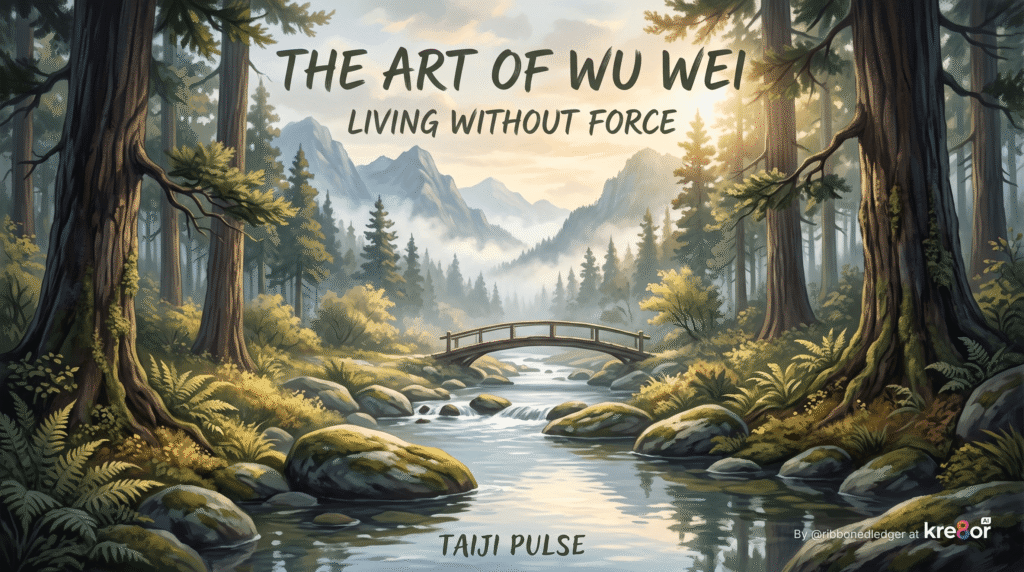
“Nature never hurries, yet everything is accomplished.”
— Lao Tzu
Introduction
When people first hear the term Wu Wei, they often misunderstand it.
Some think it means doing nothing.
Others believe it means giving up or avoiding responsibility.
In reality, Wu Wei has very little to do with inactivity.
It is the art of living without unnecessary force.
Like water flowing around a rock instead of trying to break it.
Like a tree bending with the wind instead of resisting until it snaps.
Wu Wei is not the absence of action.
It is the absence of struggle.
This principle has quietly guided Taoist philosophy for thousands of years, and it continues to influence the practice of Taiji and Qigong today.
What Does Wu Wei Really Mean?
The Chinese characters Wu Wei (無為) are often translated as “non-forcing” or “effortless action.”
That doesn’t mean we never make an effort.
It means we stop creating resistance where none is needed.
Think about breathing.
You don’t force every breath.
You allow it.
Walking happens the same way.
Balance is not something we think our way into.
It emerges when we stop interfering with it.
The same is true of life.
Nature Is Our Greatest Teacher
Spend a few moments watching a river.
It never argues with the rocks.
It doesn’t complain about the bends.
It simply continues flowing.
Over time…
the river shapes the mountain.
Not through force.
Through consistency.
Nature teaches Wu Wei every day.
The seasons don’t rush.
The sunrise doesn’t compete.
The forest doesn’t compare itself to another forest.
Everything simply becomes what it is meant to become.
Wu Wei in Qigong Practice
Many beginners try to create Qi.
Ironically…
that usually creates tension.
Instead, Qigong invites us to relax.
To stand.
To breathe.
To soften.
As unnecessary tension leaves the body, natural movement begins to appear.
Qi is cultivated.
Not forced.
One of the most valuable lessons I have learned through years of Zhan Zhuang practice is this:
Relaxation is not weakness.
It is intelligent effort.
Wu Wei in Everyday Life
Wu Wei is not limited to the practice hall.
It appears in everyday moments.
Listening before speaking.
Walking instead of rushing.
Preparing tea with full attention.
Helping someone without expecting recognition.
Doing today’s work without becoming overwhelmed by tomorrow’s.
The more we stop trying to control every outcome, the more naturally life begins to unfold.
Little Wu’s Tea Time
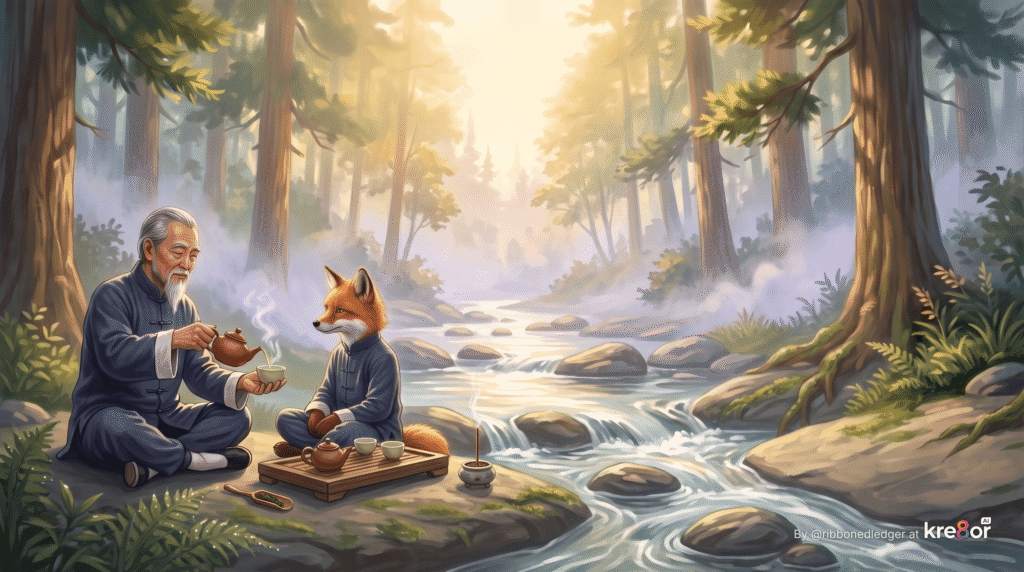
Little Wu asked,
“Master… how do I know when I am forcing life?”
The master smiled.
He poured tea into two small cups.
Then he gently placed one before Little Wu.
“Did the tea hurry to fill the cup?”
Little Wu shook his head.
“Did the cup chase the tea?”
Again, he shook his head.
The master looked toward the mountain stream.
“Everything arrived exactly when it was ready.”
Little Wu watched the steam rise quietly into the morning air.
For the first time…
he understood that peace often arrives the same way.
Living Without Force
The modern world often encourages us to push harder.
Work harder.
Move faster.
Do more.
Wu Wei offers another possibility.
Slow down enough to notice.
Act when the time is right.
Rest when rest is needed.
Trust that steady progress often accomplishes more than constant effort.
Final Thoughts
The Art of Wu Wei is not about escaping life.
It is about participating in it more wisely.
When we stop fighting every current…
we discover that many of them were already carrying us in the right direction.
Perhaps today…
instead of asking,
“How can I force this to happen?”
Ask,
“What happens if I simply take the next natural step?”
You may discover that life has been waiting for you all along.
Final Reflection
The river never struggles to reach the sea.
It simply continues flowing.
Perhaps we were never meant to pull the river—
only to walk beside it.
🍃
Internal Links
This article would naturally link to:
- The Two Clocks We Carry
- Return to the Moment: The Foundation of Qi Cultivation
- Why Stillness Can Feel Difficult in Qigong Practice
- Daily Qigong Practice Guide for Beginners
- Zhan Zhuang: The Foundation of Internal Power in Qigong and Taijiquan