
The first cold weeks of the year change what many people want to eat. Salads and cold sandwiches stop appealing, and a hot bowl starts to look like the only sensible dinner. For readers whose joints feel stiffer in winter, the shift is more noticeable, because a cold kitchen, cold hands and a cold meal can all add up to a body that feels tight before the day has begun.
A list of warming ingredients only gets you so far, because a meal is more than its ingredients. This article gives you a structure you can repeat: four parts, a handful of proportions, a cooking method and a temperature. Once you have it, how to build a warming winter meal stops being a recipe question and becomes a habit you can run on any weeknight. If you want the ingredient side of the story first, the earlier article on warming foods for stiff winter joints covers it, and this piece assumes you may have read it but does not require it.
Why the cold season changes what a good plate looks like
In winter, most people spend more time indoors, move less, and come home to a house that is cooler than they would like. Appetite tends to shift toward heavier, hotter food. That is a reasonable response, and a plate designed for winter can work with it instead of against it.
Three practical things change on a winter plate. The food is cooked more thoroughly, it is served hot, and it is eaten without much ice or chilled liquid alongside it. None of these needs special equipment or an unusual shopping list. They mostly mean choosing the soup pot over the salad bowl more often.
A good winter plate also has to be something you will actually make on a tired evening. A structure with four parts is easier to remember than a long list of foods to eat and avoid, and it leaves room for what is already in your fridge.
What food energetics means by warming, and what it does not claim
Food energetics is a traditional Chinese way of describing foods by their effect on the body, not by their nutrient content. Foods are described as cooling, neutral or warming, and meals are put together to suit the season and the person eating. Standard English-language introductions include Paul Pitchford’s Healing with Whole Foods and Daverick Leggett’s Recipes for Self-Healing, and both describe winter eating in terms of cooked, warm, well-seasoned food.
“Warming” in this framework is not the same as the temperature on the thermometer or the heat of a chilli. Ginger and cinnamon are classed as warming. So are lamb, oats and root vegetables that have been cooked slowly. Cucumber and raw salad leaves are classed as cooling. The cooking method also counts: the same vegetable is considered more warming when it is roasted or stewed than when it is eaten raw.
It is worth being plain about the limits. Food energetics is a traditional framework, not a clinical finding. It has no controlled trials showing that eating this way eases joint pain, and nothing here should be read as treatment. What the framework offers is a consistent way to choose and prepare food for the cold months, and many people find a warm, cooked, unhurried meal a comfortable one. If you want to look at what the research does and does not support, the article on whether food can really lubricate your joints goes through it carefully.
The winter plate in four parts: base, cooked vegetables, protein, and a small warming accent
Think of one bowl or plate with four parts. The proportions below are a practical starting guide, not a prescription from any study.
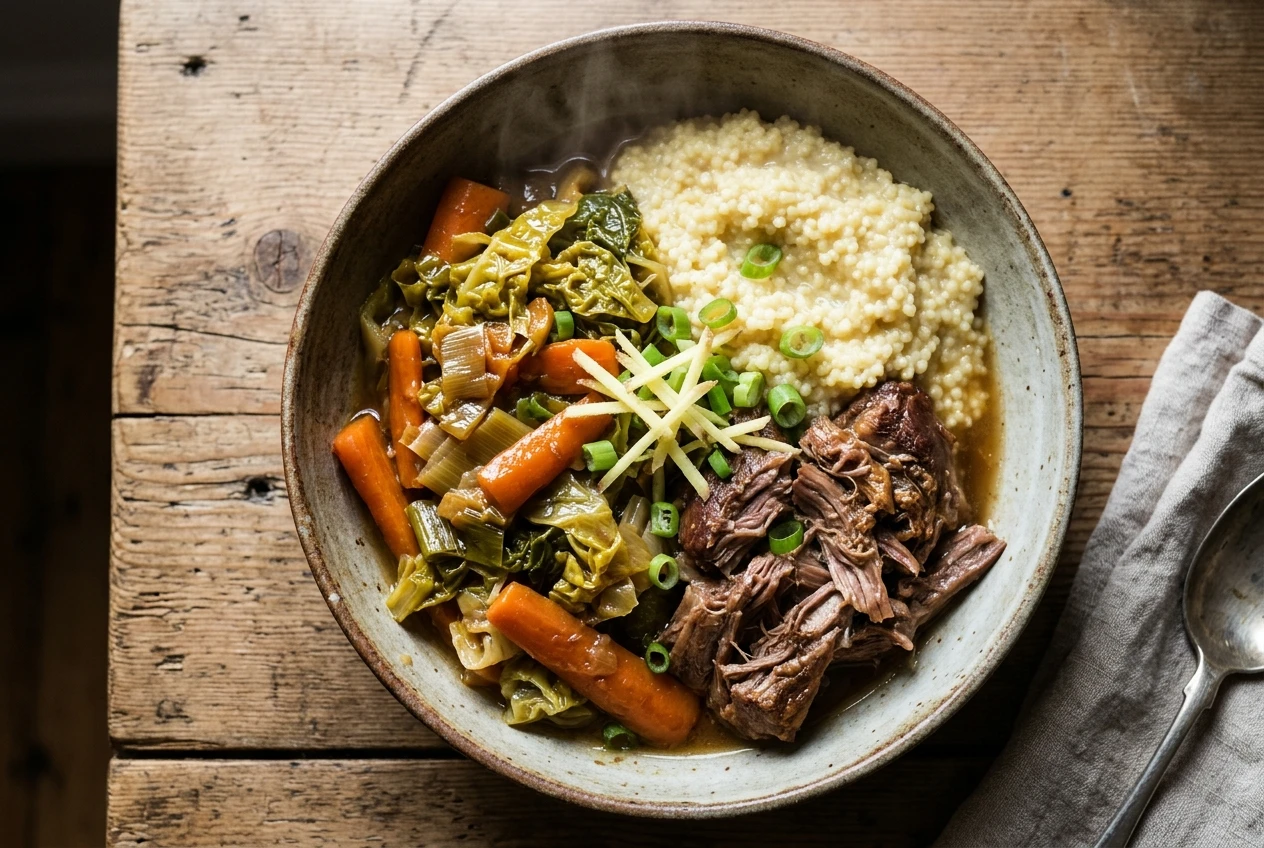
1. The base (roughly a quarter of the plate)
This is the grounding part: a cooked grain, a starchy root, or a soft legume. Porridge oats, brown rice, millet, barley, sweet potato, parsnip, potato and lentils all qualify. In the energetics tradition, cooked grains and roots are considered settling and sustaining, which suits the season.
Pick one base per meal. It keeps the meal simple and gives you something warm and soft to anchor the rest.
2. Cooked vegetables (roughly half the plate)
This is the largest part. Choose vegetables that hold up to long cooking: carrots, onions, leeks, cabbage, squash, mushrooms, celery root, kale, and similar. Aim for two or three kinds with different colours so the plate stays interesting.
Cooked is the operating word. Lightly raw vegetables are not forbidden, but in winter the framework favours giving them heat and time first.
3. Protein (roughly a quarter of the plate)
Eggs, fish, chicken, lamb, beef, tofu, tempeh, beans and lentils all fit. If you choose a legume as protein, it can also serve as the base, which makes the plate even simpler. Slow-cooked and braised protein suits the winter method best, though a soft-boiled egg on a bowl of congee is also a good example.
4. A small warming accent (a spoonful, not a serving)
This is the finishing touch: fresh ginger, a pinch of cinnamon or black pepper, a few slices of spring onion, a little toasted sesame oil or a spoonful of miso stirred into broth. It adds flavour and, within the framework, warmth. A small amount is the point. A large quantity of strong spice is not part of the idea, and for some digestions it is too much.
Cook it longer and softer: soups, stews, roasting and why method matters as much as ingredients
In food energetics, method is part of the food. A long, gentle cook is considered more warming than a quick one, and a quick cook more warming than none at all. The practical order, from most to least warming, runs roughly like this: stewing and braising, soups and congee, roasting, steaming and sautéing, then raw.
Here is how that works in a normal kitchen.
- Soups and stews. One pot, a low simmer, and the vegetables, protein and base all cooked together. Make enough for two or three meals.
- Roasting. Root vegetables roasted until the edges caramelise turn sweet and soft. Add a tray of them to the oven while you do something else.
- Congee or porridge. Rice or oats cooked in extra water until creamy, with an egg, some greens and a little ginger stirred in. It is among the gentlest meals you can make, which suits days when appetite is low.
- Braising. A tougher cut of meat or a pot of beans cooked slowly in broth until it falls apart.
There is also a sensible, non-traditional reason to like soft food. Food that is soft is easier to chew and for many people easier to digest, which is useful when you are tired or when your hands are too stiff to manage a demanding meal.
Warm drinks and the temperature of the whole meal
The framework pays attention to temperature as well as cooking. A warming meal eaten lukewarm, or washed down with iced water, loses much of what it was designed for. So the last piece of the plate is the plate itself: serve it hot and eat while it is still warm.
Some simple habits follow from that:
- Warm your bowl with hot water for a minute before serving a soup or stew.
- Drink warm or room-temperature water, or a simple tea such as fresh ginger slices steeped in hot water, instead of ice-cold drinks with the meal.
- Sit down to eat. A meal that cools on the counter while you are busy is no longer the meal you cooked.
If you want a gentle way to slow down once the food is hot, the article on eating slowly the Taiji way offers a way to treat the meal as a short, quiet practice. Hydration is its own subject, and drinking enough across the day is a separate question from what you drink with dinner.
Adjusting the plate for your own body, appetite and any health conditions you have
A structure is only useful if it fits the person using it, and food energetics itself says that bodies differ. Someone who runs warm, sleeps badly and feels flushed after spicy food may do better with a gentler accent, such as a few slices of spring onion, and no chilli at all. Someone who feels cold easily may like a bit more ginger.
Useful questions to ask after a few meals:
- Did the meal sit comfortably, or did you feel heavy or bloated?
- Did you feel hungry again an hour later, or satisfied for a good while?
- Did you feel pleasantly warm, or overheated and restless?
- How did your joints and general energy feel the next morning? Keep this one loose and unscientific. One good or bad morning tells you very little, and weather, sleep and activity all play a part.
Adjust one thing at a time. Change the accent, or the amount of base, or the cooking method, and see how it goes for several days.
Some conditions need more than self-observation. If you have diabetes, kidney disease, a digestive condition, a history of gout, or you take regular medication, talk to your doctor or a registered dietitian before changing how you eat. Some foods and spices interact with certain medicines, and a plate that suits one person’s health may not suit another’s. Joint pain that is new, severe, getting worse, or accompanied by swelling and heat also deserves a medical assessment first. Clinical guidance on osteoarthritis, such as the NICE guideline in the UK, puts exercise, weight management and professional support ahead of any specific food, and a warming meal is best treated as a comfortable addition to those, not a replacement.
If you would like more detail on individual foods and how they are classed, a beginner book on Chinese food energetics can serve as a reference to keep in the kitchen. Choose one that explains its reasoning in plain language and is honest about its traditional basis.
A week of plates without extra shopping or effort, plus a note on pairing eating with Qigong
You do not need seven different recipes. Choose one base, two vegetables, one protein and one accent on shopping day, then vary how you cook them. A week might look like this:
- Monday: A big pot of vegetable and lentil soup, with leftover oats or rice stirred in. Cook enough for three meals.
- Tuesday: Reheated soup with a soft-boiled egg and a few ginger slices on top.
- Wednesday: Roasted carrots, parsnips and onions over barley, with chicken thighs baked on the same tray.
- Thursday: Leftover roasted vegetables folded into a simple broth with miso for a quick bowl.
- Friday: Congee made with rice, greens and an egg, finished with sesame oil.
- Saturday: A slow braise of beans or lamb with root vegetables, left on a low heat while you do other things.
- Sunday: Leftover braise over mashed sweet potato, with a pinch of cinnamon or pepper.
Every night uses the same four parts, and almost everything comes from the same short shopping list. The cooking effort is concentrated on two or three evenings, and the rest is reheating.
Eating and movement work well together in winter. A few minutes of gentle practice before dinner can help you arrive at the table less rushed, and the article on winter Qigong for kidney qi describes a quiet routine suited to the season. Neither the food nor the practice is a cure for stiff joints, but both ask you to slow down and pay attention, which is a useful thing to do in the darkest months.
One thing to try this week
Choose one dinner this week that would normally be cold or raw, such as a sandwich, a large salad or something eaten straight from the fridge. Replace it with a warm, cooked plate built from the four parts: a soft base, two cooked vegetables, a protein and a small warming accent, served hot with a warm drink.
Do the same on two or three evenings, and notice how you feel afterwards: how comfortable your stomach is, how warm you feel, and how your body feels the next morning. Write down a line or two each time. After a few evenings you will have your own notes, which are more useful for adjusting the plate than any general advice.