
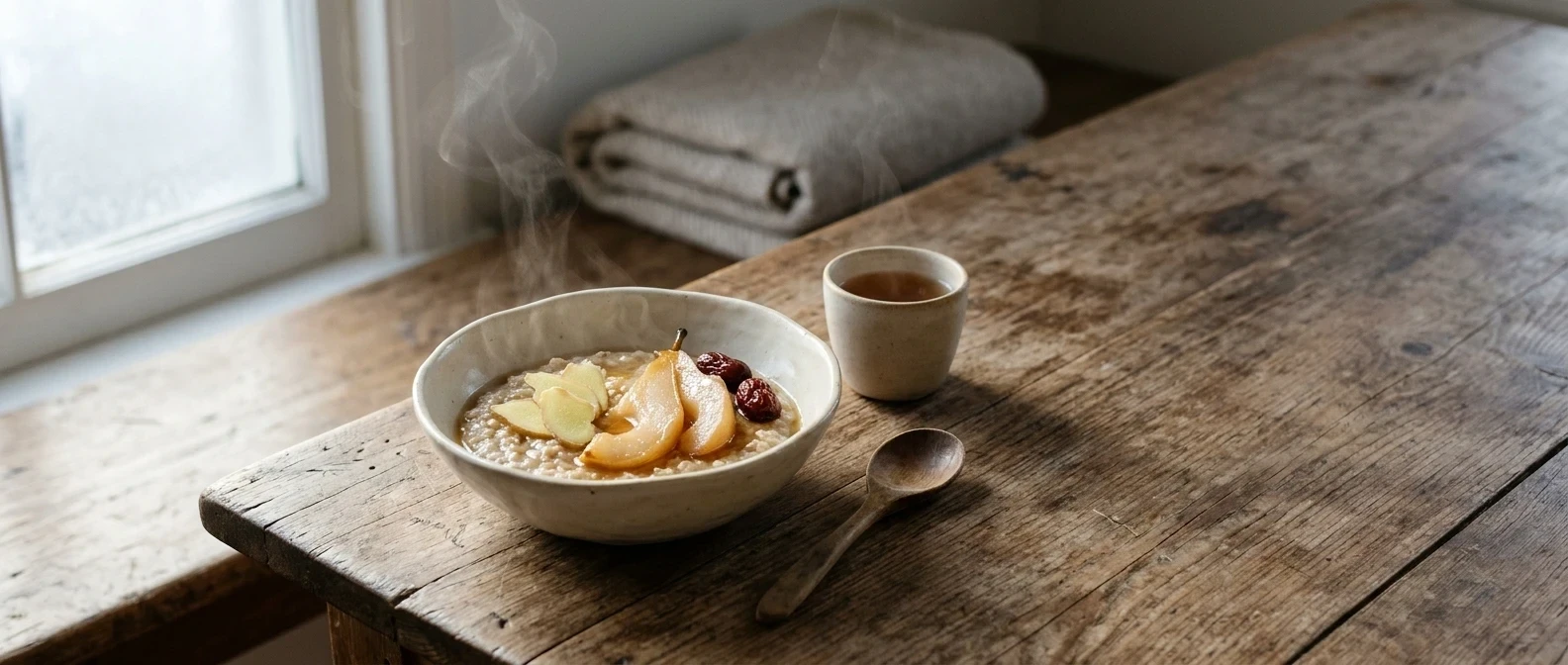
Cold mornings make many people with stiff joints reach for something hot to eat and drink. That habit lines up with a long tradition in Chinese food energetics, where certain foods are called warming. It is worth understanding what that tradition claims, what research can say about food and joint comfort, and how little it takes to build a gentle winter routine around it. This guide covers warming foods for joint pain in winter without promising relief, then pairs one simple breakfast with a few minutes of Qigong joint movements.
Why Joints Can Feel Stiffer When the Weather Turns Cold
Many people report that their joints feel worse in cold, damp weather, and researchers have looked at the question. The UK study “Cloudy with a Chance of Pain,” led by the University of Manchester and published in 2019, collected daily pain reports from thousands of people with long-term pain. It found that days with higher humidity, lower air pressure and stronger wind were linked to a modestly higher chance of pain. The effect was small and differed a lot from person to person.
So the weather link is real for some people and weak for others, and science has not settled why. Everyday habits probably play a part too. In winter we tend to sit more, go outside less, and hold our shoulders up around our ears against the cold. Joints that stay in one position for hours feel stiffer when you finally stand up.
This matters for the rest of the article because it points to two things you can control: what you eat and how you move in the morning. Neither is a cure. Both are small, low-risk parts of a day.
What “Warming Foods” Means in Food Energetics, and What It Does Not Mean
In traditional Chinese dietary thinking, foods are described by their “nature” or “temperature,” ranging from cold and cool through neutral to warm and hot. This describes the effect a food is traditionally said to have on the body. It has nothing to do with how hot the food is when you eat it, and it is not the same as spiciness, although several warming foods are pungent.
Traditional Chinese medicine also has its own account of joint complaints. Aching, stiff joints that worsen in cold and damp weather are described under the heading of “bi” patterns, attributed to wind, cold and damp settling in the body. Warming foods in winter are part of that framework: the idea is to eat in a way that supports the body against the cold season.
Here is what the idea does not mean. It does not mean these foods treat arthritis, and it does not mean cold foods cause joint pain. It also does not replace medical care. Food energetics is a traditional system of observation, not a set of findings from controlled trials. You can find it useful as a way of choosing cooked, seasonal, comforting meals while holding it separately from what the clinical evidence shows.
Sources also disagree with each other. A food listed as warm in one book may be listed as neutral in another, so treat any list, including the one below, as a starting point.
What Research Does and Does Not Say About Food and Joint Comfort
Warming is a traditional category rather than a nutritional or medical one, so clinical trials do not test it as a group. Research looks at individual foods and at overall eating patterns, and the findings are modest.
- Overall guidance for osteoarthritis. The 2019 American College of Rheumatology and Arthritis Foundation guideline for hand, hip and knee osteoarthritis strongly recommends exercise, and weight loss for people with knee or hip osteoarthritis who are living with overweight. It conditionally recommends tai chi. Its dietary recommendation concerns body weight, not any particular food.
- Eating patterns. The Arthritis Foundation describes Mediterranean-style eating, with plenty of vegetables, fruit, whole grains, nuts, olive oil and fish, as a sensible general pattern for people with arthritis. It is promoted for overall health, not as a joint treatment.
- Ginger. A 2015 meta-analysis by Bartels and colleagues, published in Osteoarthritis and Cartilage, pooled trials of ginger in people with osteoarthritis and found a modest benefit for pain. The trials varied in quality and design, so the result is suggestive, not firm.
- Omega-3 fats. The US National Center for Complementary and Integrative Health (NCCIH) notes that fish oil has shown some modest benefit for symptoms of rheumatoid arthritis in studies. That evidence concerns fish oil supplements in a specific condition, not walnuts at breakfast.
- Gout. Food does matter a great deal for some types of arthritis. If you have gout, the foods and drinks that raise uric acid, alcohol among them, are worth discussing with your doctor.
In short, moving regularly and keeping a comfortable body weight have much stronger support than any single food. A warm, well-cooked breakfast is a pleasant addition to that, and nobody should expect it to change their pain.
Seven Warming Foods to Start With, and Simple Ways to Cook Them
These are commonly listed as warming in food energetics sources. Classifications vary, so you may see small differences between books.
- Fresh ginger. Slice a few coins into a pot of hot water for tea, or grate a little into porridge, soups and stir-fries. Start with a small amount, since it can upset some stomachs.
- Cinnamon. Stir a half teaspoon into oatmeal, stewed fruit or warm milk. A light dusting is enough.
- Scallions (spring onions). Slice them into congee, eggs or miso soup at the end of cooking so they stay fresh and mild.
- Walnuts. Eat a small handful on porridge, or toast them in a dry pan for a few minutes until fragrant.
- Garlic. Cook it gently in a little oil at the start of a soup or a vegetable dish. Cooked slowly, it is milder than raw.
- Chicken or lamb. Simmer chicken thighs in broth with ginger and scallion, or braise lamb slowly with onion and a few spices. Long, gentle cooking suits the winter idea.
- Oats. Some sources call oats warm and others neutral, but a bowl of cooked oats is the easiest warm breakfast most people can make.
Cooking method counts in this tradition. Soups, stews, porridges and steamed dishes are favored in winter over raw salads and iced drinks, simply because they arrive warm and are easy to digest. If you take blood-thinning medication or any regular prescription, check with your doctor or pharmacist before adding large amounts of ginger or supplements.
A Warm Winter Breakfast That Takes Ten Minutes
Ginger-cinnamon oatmeal with walnuts uses four of the seven foods above and needs one pot.
Ingredients for one bowl:
- Half a cup of rolled oats
- One cup of water, or half water and half milk of your choice
- A pinch of salt
- Half a teaspoon of finely grated fresh ginger
- Half a teaspoon of ground cinnamon
- A small handful of walnuts, roughly chopped
- Optional: a sliced apple or pear, or a teaspoon of honey
Method:
- Put the oats, liquid, salt and ginger in a small pot over medium heat.
- Stir now and then for about five minutes, until the oats are soft and thick. Add a splash of water if it gets too stiff.
- Stir in the cinnamon and the apple or pear, if using, and cook for another minute.
- Pour into a bowl, top with the walnuts, and add honey if you like.
- Eat it sitting down, slowly, while it is still hot.
Total time is about ten minutes. Grate the ginger the night before and keep it in a covered dish in the fridge if mornings feel rushed. Fresh ginger varies in strength, so begin with less and add more next time if you like the taste.
Pairing Your Meal With a Few Minutes of Gentle Qigong Joint Warm-Ups
Stiff joints usually respond better to gentle movement than to rest, which is why the guideline above puts exercise first. Qigong joint rotations are slow, low-impact and easy to do in a kitchen, before or after breakfast. Move within a comfortable range and stop if anything feels sharp.
Stand with your feet about shoulder-width apart, knees slightly soft, weight even on both feet. Breathe in through the nose and out slowly, and spend about thirty seconds on each of these:
- Neck. Turn your head slowly to the right, return to center, then to the left. Skip full circles if they bother you.
- Shoulders. Roll them backward in slow, wide circles, then forward.
- Wrists and fingers. Make loose fists, circle the wrists in both directions, then open and close the hands several times.
- Waist and hips. With hands on your hips, draw a slow, small circle with your pelvis, then reverse direction.
- Knees. Rest your hands on your thighs just above the knees and make small, gentle circles with the knees, keeping the movement shallow.
- Ankles. Lift one foot slightly, rotate the ankle in both directions, then change feet. Hold a counter for balance if you need it.
Together that is about three minutes. Keep the breathing unhurried and let the movements be smaller than you think they should be. If you want to see how Taiji, a close relative of Qigong, can support the knees, hips and shoulders over time, How Taiji Looks After Your Knees, Hips and Shoulders as You Age goes into it.
When Food Is Not the Answer and It Is Time to Talk to Your Doctor
Stiffness that eases within a few minutes of getting up and moving is common and often mild. Some signs call for a medical appointment instead of a different breakfast:
- A joint that is red, hot or visibly swollen
- Pain that wakes you at night or keeps getting worse over weeks
- Morning stiffness that lasts longer than about thirty minutes
- Sudden severe pain in a single joint, especially with fever
- Joint pain after a fall or injury
- Any new symptom that worries you
Inflammatory conditions such as rheumatoid arthritis, and gout, are treated best when they are found early, and no food or movement routine should delay that. If you have a diagnosis, ask your doctor or a registered dietitian what suits your situation before changing what you eat in a big way, and let them know about any Qigong or Taiji practice you start. Both can sit alongside medical care.
One Small Thing to Try This Week
Pick one morning this week and make the ginger-cinnamon oatmeal above. Before or after you eat, do three minutes of gentle Qigong joint rotations: neck, shoulders, wrists, hips, knees and ankles, slowly, with easy breathing. Afterward, take a moment to notice how your body feels, without grading it. You can do it again another day and see whether you prefer moving before breakfast or after.
If the seasonal side of this interests you, Eating With the Seasons When You Practice Qigong gives the wider picture across the year.
For readers who want to go deeper into food energetics, Paul Pitchford’s Healing with Whole Foods is a widely read reference that covers the temperature of foods along with much else about eating by season. It suits people who enjoy a long, detailed book to dip into over time. If you only want a few simple recipes, the ideas in this article will take you a long way without it.