
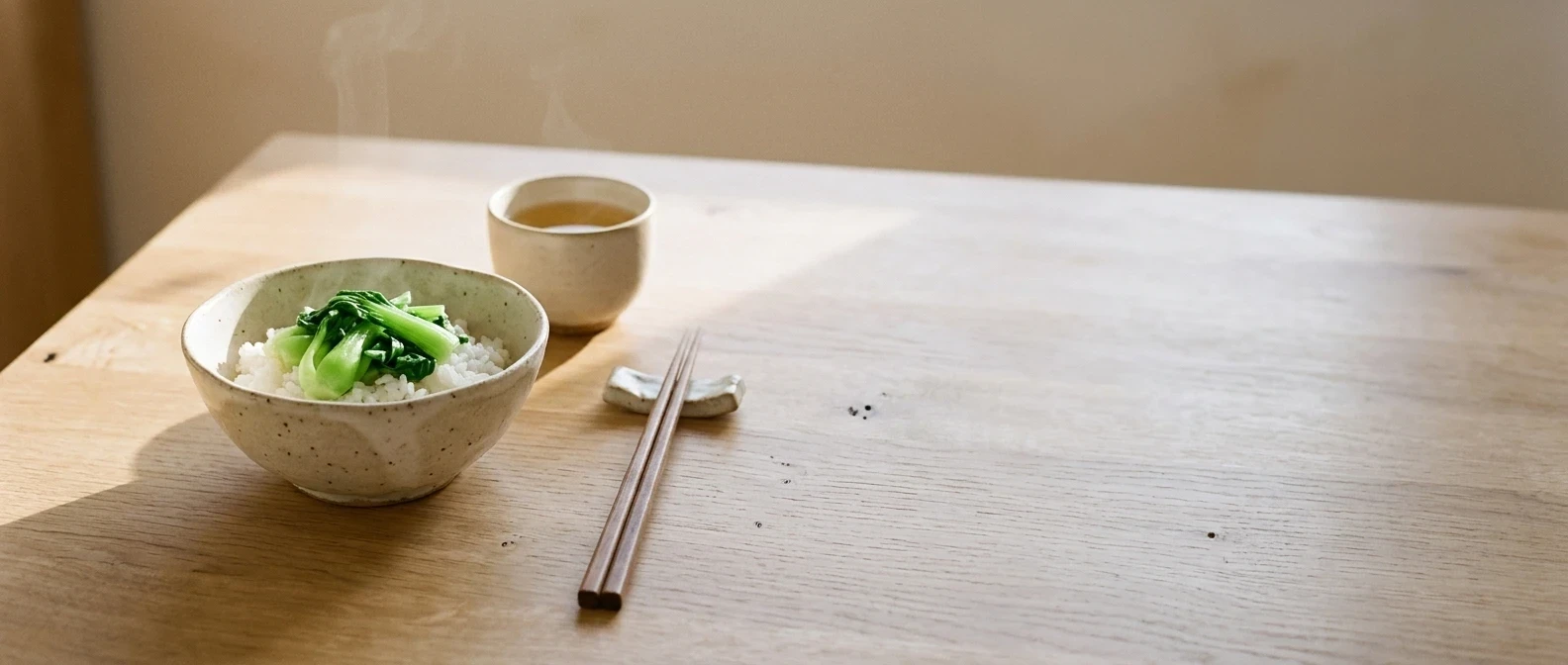
Most people eat while doing something else: reading, scrolling, driving, answering a message. The meal gets finished, but hardly anyone is present for it. Taiji and Qigong practice offers a different way to spend those twenty minutes.
Mindful eating as meditation means treating the meal as the object of your attention, the way a slow form treats the movement of your arms. This article takes three Taiji principles (rooting, softness, and slow, even movement) and applies each to a single meal, from sitting down to the last bite. It is about how you eat, and says nothing about what you eat.
Why a meal can be practiced like a form
A Taiji form has a clear start, a middle where attention can drift, and an ending where you finish deliberately. A meal has the same shape. You sit, you eat, you stop. Between those points you make dozens of small, repeated movements: lifting, placing, chewing, swallowing, setting down.
Those movements are physical, and they happen at a pace you control. That makes a meal a convenient place to practice what you already know from the form. You do not need extra time, special clothing, or a quiet room. You need a seat, a plate, and the willingness to go a little slower than usual.
The practice is also forgiving. If you have stiff or achy joints and standing practice is hard some days, a seated meal asks very little of your body. Nothing about it requires a deep stance or a long hold.
Rooting before the first bite: how you sit, your feet and your breath
In Taiji, rooting means your weight settles down through the legs and feet into the ground, so the upper body can stay light. At a table, the same idea starts with the chair.
Before you pick up anything, take a few moments to set up:
- Feet: Place both feet flat on the floor, roughly hip-width apart. If they do not reach, put a firm cushion or a folded towel under them. Feel the whole sole, not just the heels.
- Sit bones: Sit toward the front half of the seat so your weight drops through the sit bones instead of leaning back against the chair.
- Spine: Let the head float up as if suspended from the crown, with the chin slightly tucked. This is the same upright, unforced posture you would use standing.
- Shoulders and chest: Let the shoulders drop away from the ears and the chest soften instead of puffing out.
Then take one slow breath. If you have learned abdominal breathing, let the belly expand gently on the inhale and settle on the exhale. If you have not, the Taiji breathing guide for beginners explains the basic pattern. One breath is enough. The point is to mark a clear start, the way a form begins with a moment of standing still.
Look at the food for a few seconds. Notice colors, steam, how it is arranged. This is a short pause, and it tells your body that the meal has started.
Soft hands, slow movements: the fork, the cup and the chew
Softness in Taiji does not mean weakness. It means releasing tension you do not need, so the movement uses only the effort it requires. Many people grip a fork as if it might escape, with a raised shoulder and a tight jaw.
Try this instead. Hold the fork or spoon lightly, with the fingers relaxed. Let the elbow hang slightly away from the body and the shoulder stay low. If your wrists or finger joints are stiff, a utensil with a thicker handle can make a loose grip easier, and a loose grip is gentler on achy hands.
Moving at an even pace
Taiji movements are slow and even, with no sudden starts or stops. The fork can move the same way. Lift it at a steady speed, bring it to your mouth without hurrying, and lower it at the same speed. Then set the utensil down on the plate or the table between bites. This is the hardest part of the practice for most people, because it breaks the habit of loading the next forkful while still chewing.
The cup works the same way. Lift it slowly, notice the weight and the temperature in your palm, drink, and set it down.
The chew
Chewing is the slowest movement of the meal, and the easiest to rush. Give each mouthful your attention while it is in your mouth. Notice texture first, then flavor, and how both change as you chew. You are not counting chews or following a rule about a set number. You are staying with the mouthful until you swallow it, then breathing before the next one.
If your jaw is tight, let it loosen on purpose. The teeth do not need to clench, and the tongue can rest softly.
Letting the body say when it is enough
Taiji training asks you to listen: to your weight shifts, your balance, your partner’s push. At a meal, the thing to listen to is hunger and fullness.
Pause halfway through the plate. Rest your hands in your lap and take a breath. Ask a plain question: how hungry am I now, compared with when I sat down? You are looking for a rough answer, not a score.
Fullness tends to arrive gradually, and eating very fast can make it easy to pass the point of comfort before noticing it. Slowing down gives you more chances to notice. You may still finish the plate, and that is fine. You may leave some, which is also fine. The practice is in noticing, not in following a rule about how much to eat.
If you eat on a schedule for a medical reason, such as managing blood sugar or following a plan from a dietitian, keep to what your care team recommends. Listening to your body is something to add, not a replacement for their advice.
What mindful eating can and cannot do for you
Mindful eating is a calming habit. Many people find that slowing down makes meals more enjoyable and the day a little less rushed. Harvard’s The Nutrition Source describes mindful eating as paying full attention to the experience of eating and drinking, including the food, your body’s cues, and your thoughts and feelings about it.
Research on its health effects is mixed, and many studies are small or short, so it is best to treat it as a supportive habit rather than a proven treatment. It does not cure digestive conditions, treat joint pain, or replace medical care. Taiji and Qigong practice sit in the same category: gentle, worthwhile, and not a substitute for advice from your doctor.
A few cautions:
- If you have a history of an eating disorder, paying close attention to hunger and portions may be unhelpful, and it is worth talking to a clinician before trying this.
- If you have trouble swallowing, ask your doctor or a speech-language pathologist before changing how you eat.
- If you take medication that must be taken with food or at certain times, keep to that timing.
For a fuller look at the approach, Savor: Mindful Eating, Mindful Life by Thich Nhat Hanh and Lilian Cheung, a Harvard nutrition professor, is a widely read beginner book on the subject.
When your mind wanders mid-meal, and why that is part of the practice
Your attention will leave the meal. You will think about tomorrow’s appointments, or realize that the last four bites went by unnoticed. This happens to everyone, and it is the same thing that happens in standing or seated Qigong.
Noticing that your mind has wandered is the practice. In that moment you are present again, however briefly. Return to something physical: the weight of your feet, the utensil in your hand, the taste in your mouth. Then continue. There is no need to start the meal over or to judge how well it went.
If stillness feels uncomfortable in general, why stillness can feel difficult in Qigong practice covers why that happens and how to work with it. A meal is a gentler place to begin than a long sit, because there is always something to do with your hands and mouth.
One meal to try this week
Choose a single meal where you will be seated and not rushed. A quiet breakfast or a weekday lunch is easier than a family dinner. Put your phone out of reach and turn off the screen.
Here is the whole sequence in order:
- Sit with both feet flat and your weight on the sit bones.
- Let your shoulders drop and take one slow breath.
- Look at the food for a few seconds.
- Pick up the utensil loosely and move it at an even pace.
- Put it down between bites and chew until you have swallowed.
- Halfway through, rest your hands and check how hungry you still are.
- When you finish, sit for one more breath before standing.
If the whole meal feels like too much, shorten it. The first five minutes are enough to start, because that is when you are most likely to rush.
If you are curious about what to put on the plate as well as how to eat it, eating with the seasons when you practice Qigong offers a gentle starting point.
One thing to try: this week, eat the first five minutes of one meal in silence, with your feet flat on the floor and one slow breath before the first bite. Then notice what changed, if anything, and eat the rest of the meal however you like.