
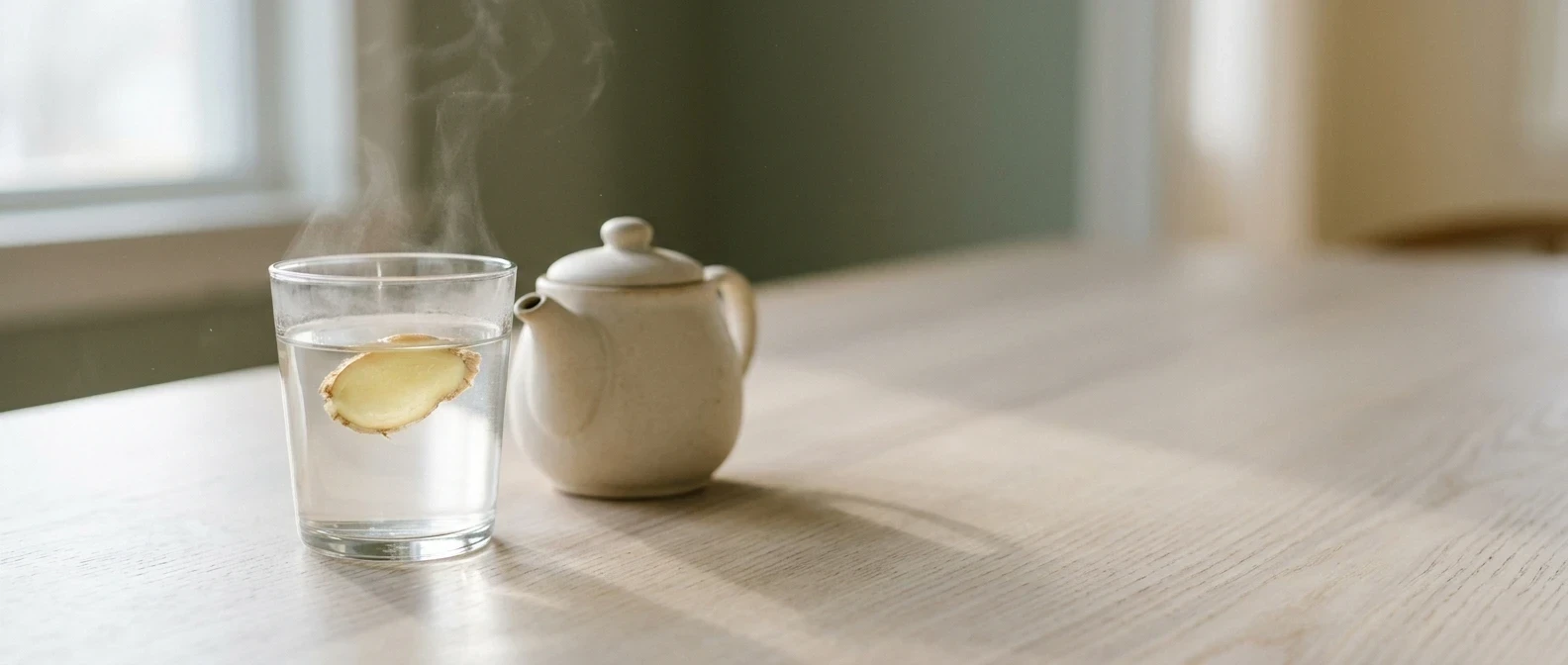
Stiffness on waking has many causes, and water is only one of them. Joints and the tissue around them are cushioned and lubricated by fluid, and many people go through the night without drinking anything for seven or eight hours. A body that wakes a little dry and a little still is a reasonable place to start asking questions.
This article looks at what is reasonably understood about hydration, fascia and joint comfort, then at how Chinese medicine describes fluids and qi moving together. It ends with a small daily habit. The two views are kept apart on purpose: the research is cautious and the traditional lens is a tradition, and each is more useful when it is not dressed up as the other.
What hydration can and cannot do for joints and fascia
Water is a large part of how joints work. Standard anatomy references describe articular cartilage as mostly water, and the synovial fluid inside a joint capsule is a water-based lubricant. Fascia, the connective tissue wrapped around muscles, organs and bones, also holds a good deal of water.
That does not make water a treatment for achy joints. If you are already well hydrated, drinking more is unlikely to ease arthritis pain, and no reliable evidence presents it as a remedy. Being clearly dehydrated is a different matter, because it can make you tired, light-headed and stiff in general, and fixing that is sensible.
So water is a sensible foundation that is easy to neglect, and it has limits. It will not repair cartilage, reverse osteoarthritis or replace medical care. A fair claim is that staying adequately hydrated supports the normal working of your tissues, and that is worth doing alongside gentle movement.
There is one age-related detail. Research on ageing, including work by Kenney and Chiu on thirst and fluid intake, has found that the sense of thirst can weaken in older adults. In midlife and beyond, waiting until you feel thirsty may mean you are already behind, and drinking at set points in the day can help.
Fascia, glide and movement: what researchers say so far
Fascia has become a busy research area. The Fascia Research Congress, which has met regularly since 2007, brings together anatomists, physiotherapists and movement teachers. Robert Schleip, a researcher who has written widely on the subject, describes healthy fascia as made of layers that slide against one another, with water and hyaluronan helping that glide.
One idea often repeated in this literature is that fascia behaves a little like a sponge. Under stretch or pressure, some fluid is pressed out, and when the load is released fresh fluid flows back in. Schleip and others have proposed this as part of why varied, slow movement may be good for connective tissue. It remains a hypothesis. It is supported by laboratory work and anatomical reasoning, and it has not been shown in the way a drug trial shows an effect.
What is better supported is that gentle exercise helps people with joint pain. A 2016 trial by Chenchen Wang and colleagues, published in the Annals of Internal Medicine, compared Tai Chi with standard physical therapy in people with knee osteoarthritis. Both groups improved, and Tai Chi did at least as well as physical therapy over the study period. That is one trial in one condition, and it does not show that Tai Chi works by moving fluid. It does support slow, structured movement as a reasonable option for stiff knees.
The honest summary is that fluid, fascia and movement probably interact, that the details are still being worked out, and that nobody can promise you a result.
How traditional Chinese medicine describes fluids and qi moving together
Chinese medicine has its own vocabulary for this. The term is jin ye (津液), usually translated as body fluids. Giovanni Maciocia, whose The Foundations of Chinese Medicine is a standard English-language text, explains that jin are the lighter, thinner fluids that moisten skin and muscle, while ye are denser fluids that lubricate the joints and nourish the brain and marrow.
In this framework fluids do not move on their own. Qi, the functional energy of the body, is said to transform and transport them. When qi flows well, fluids spread where they are needed. When qi is weak or stuck, fluids may gather as heaviness or swelling, or fail to arrive and leave a dryness or stiffness. The reverse also holds, because fluids are said to carry and anchor qi. The two are described as partners.
Some researchers have looked for physical counterparts to these ideas. Helene Langevin and colleagues proposed in 2002 that acupuncture points and meridians might correspond in part to planes of connective tissue. This is an interesting hypothesis that has not been settled. It is reasonable to hold the traditional picture as a lens that gives a practical way of paying attention to your body, rather than as a proven mechanism.
Seen that way, the lens suggests something useful. Drinking enough and moving gently are two halves of one habit, and neither does much on its own.
Why slow Taiji and Qigong movement suits a well-hydrated body
Slow movement asks a lot of the joints in a quiet way. Weight shifts, gentle rotations, soft knees and open shoulders take the joints through a comfortable range without impact. Taiji and Qigong forms tend to move every major joint, which fits what the fascia literature suggests: varied, unhurried loading.
Practising slowly also lets you notice. A dry, tight morning feels different from a well-supplied, loose one, and slow movement gives you time to feel the difference. The traditional view would say that breath and attention guide the qi, and the fluids follow. Whether or not you take that literally, steady breathing and relaxed attention are calming, and calm muscles hold less tension around a stiff joint.
Qigong is not a replacement for medical advice, and it should never be pushed into pain. Stay inside a range that feels easy, shorten the movement if a joint complains, and sit down for any exercise if standing is uncomfortable. If you would like guidance from a person rather than an article, how to choose a Qigong teacher when you are new and a little stiff covers what to look for and what to ask.
Warm, sipped and seasonal: simple ways to drink that fit your day
Three habits suit midlife beginners well, and none of them needs equipment.
- Sip rather than gulp. Small amounts through the day are easier to absorb comfortably than a large volume at once, and they spare you repeated trips to the bathroom.
- Choose warm when it suits you. Chinese dietary tradition favours warm or room-temperature drinks, especially in cooler months. There is no strong evidence that warm water hydrates joints better than cold. It is a matter of comfort, and many people find a warm cup easier to drink on a chilly morning.
- Tie drinking to things you already do. A glass when you wake, one with each meal, and one after a walk or a Qigong session gives you a pattern without counting.
How much you need varies with your size, the weather, your activity and your health. The NHS offers a simple rough guide: pale, straw-coloured urine usually suggests you are drinking enough, and darker urine suggests you may need more. Tea and other drinks count toward your intake, and soups and fruit contribute too.
The season matters in the traditional view. Autumn is described as a dry season, and the lungs and skin are said to need moisture then, while winter calls for warmth. If you want food ideas that fit the cold months, warming foods for stiff winter joints pairs them with a morning routine.
When to check in with a doctor about thirst, swelling or persistent joint pain
Some signs deserve a conversation with a doctor rather than a new habit.
- Joint pain that lasts for weeks, wakes you at night or keeps getting worse.
- A joint that is hot, red or visibly swollen, especially if it appears suddenly.
- Swelling in the ankles or legs, or sudden weight gain, which can relate to the heart, kidneys or other conditions.
- Unusual or constant thirst, or passing much more urine than normal, which can be a sign of conditions such as diabetes.
- Morning stiffness that lasts longer than half an hour or so.
Check also before increasing fluids if you have heart or kidney disease, take diuretics, or have been told to limit fluids. In those cases more water may not be appropriate. Nothing in this article replaces the advice of someone who knows your history.
One thing to try: a glass of warm water and five minutes of gentle shoulder and hip circles
Tomorrow morning, before tea, coffee or your phone, drink a glass of warm water slowly. Then stand with your feet about hip-width apart, knees slightly soft, arms hanging. If standing is uncomfortable, sit on the front half of a chair with your feet flat.
Begin with the shoulders. Lift them gently toward your ears, roll them back and down, and repeat slowly for about a minute. Reverse the direction for another minute. Keep your breathing slow and let your jaw relax.
Then place your hands on your hips and move your pelvis in a small, slow circle, as if tracing the rim of a bowl. Do about a minute each way. Make the circles as small as you like, and stop or shrink the movement at any twinge. Finish with a minute of standing still, hands resting low on your belly, noticing how your body feels.
If you do this for a couple of weeks, notice what changes in how your mornings feel. Keep the observation modest and let it guide how long you carry on.
To go further with how food supports your practice, read Eating With the Seasons When You Practice Qigong: A Gentle Starting Point, which fits well alongside this habit.