
The worry that keeps stiff beginners at home: “I’m not flexible enough”
Plenty of adults with stiff hips, achy knees or a tight lower back picture Taiji Quan as slow, graceful stretching, and decide they are too stiff to start. The picture comes from photographs of low stances and long, extended arms. Those poses show what some advanced practitioners can do. They are not what a first class asks of you.
Taiji does ask for something, but flexibility is not at the top of the list. The first thing it trains is the ability to move your weight from one leg to the other without wobbling, jerking or leaning, and to stay centred while you do it. People who feel stiff can practise that at almost any level of mobility, because it works in a small range.
This article looks at why balance and stability come before range of movement, why a small step is usually easier on knees and hips than a deep one, and what the research on Taiji and balance does and does not show.
What Taiji is actually asking your body to do
Strip a Taiji form down and most of it is the same action repeated in many shapes: one leg takes the weight, the other becomes light, and the body moves over the supported leg before anything else happens. Hands and arms travel while the lower body does this quiet work underneath.
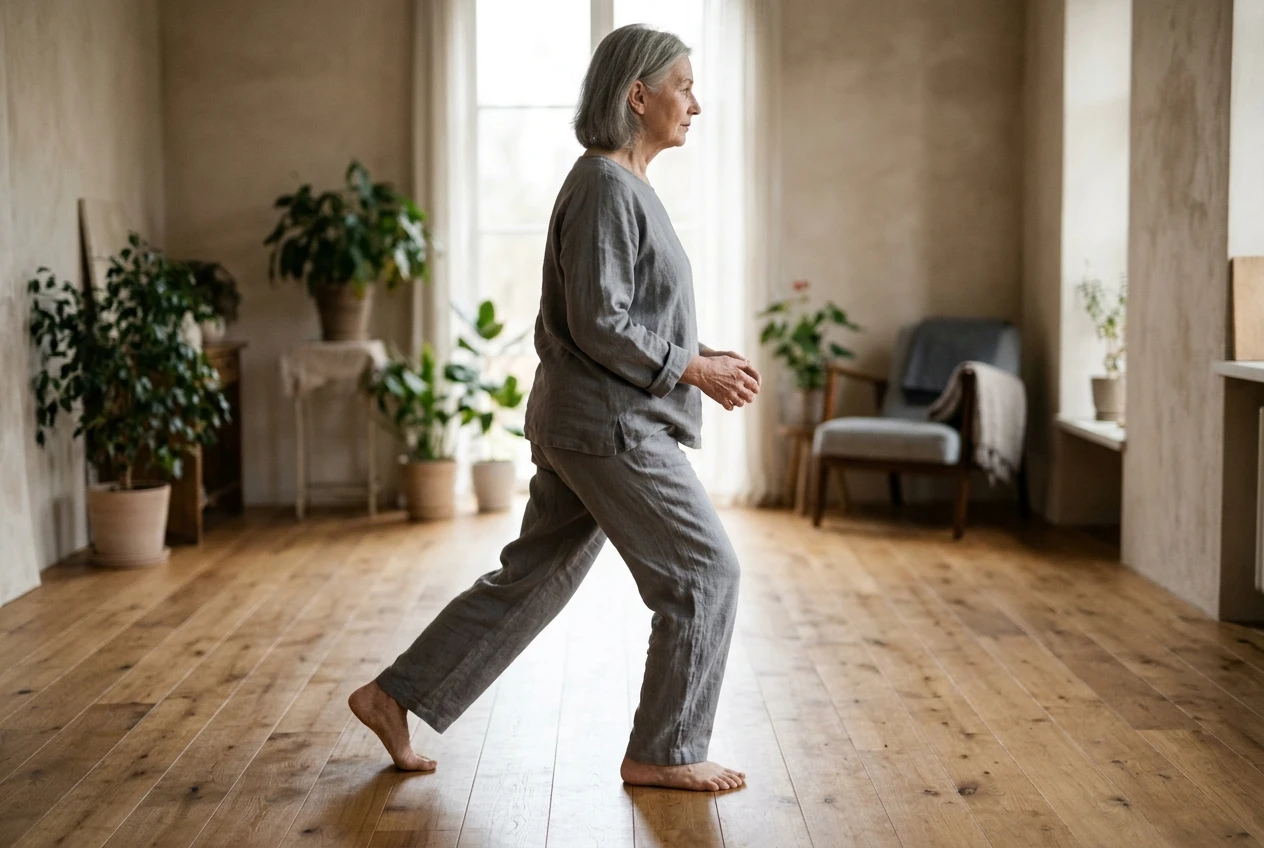
That means three things are being asked of you:
- Shift weight slowly. The move from one foot to the other is gradual, so your muscles and joints have time to adjust along the way.
- Keep one leg light. The leg without the weight is not committed. It can step, turn on the heel or stay where it is.
- Stay centred. Your head, ribs and pelvis stack roughly over the supporting foot instead of drifting off to one side.
None of these needs a deep squat or a high kick. A person who can only bend the knees a little can still shift weight evenly, and that skill is the one the form builds. Where your weight settles once you have shifted is a separate subject, covered in where your weight really goes when you root in Taiji. Here the focus is the shift itself and how steady you are while it happens.
Why a small, balanced step is kinder to knees and hips than a deep stretch
A knee or hip that already aches does not need to be pushed to the end of its range. As a general rule of biomechanics, the more deeply the knee bends under load, the more force passes through the joint, and a wide stance with the weight loaded asks the hip to rotate and bear weight at the same time. For a stiff joint, that combination is where discomfort tends to start.
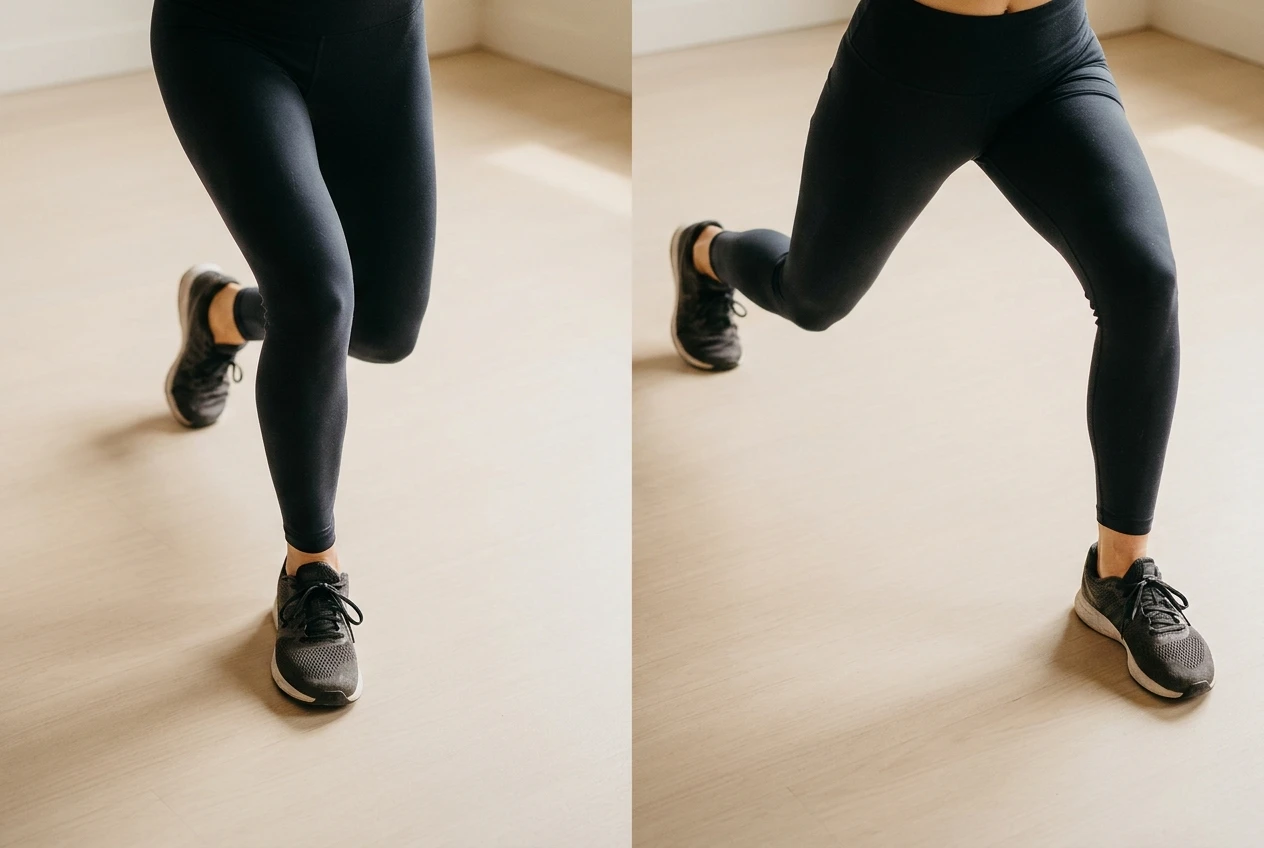
A shorter step with a higher stance changes the maths in your favour:
- The knees bend only as far as they can go comfortably, so the load stays moderate.
- The step is short enough that you can keep your knee pointing the same way as your toes, instead of letting it fall inward to reach.
- The hip does not have to rotate and carry body weight at its limit.
- You can slow down without your legs shaking, and slowness is what makes the movement trainable.
There is also a practical advantage. When you are not straining to reach a shape, you can feel what your standing leg is doing. That feedback is how balance improves. A deep stance often hides it, because effort and discomfort drown out the small signals from your foot and ankle.
If your knees are the main concern, five small adjustments that make Taiji kinder on sore knees goes through specific changes to try.
How balance is trained in the form
Balance in Taiji is not trained by standing on one leg for as long as you can. It is trained through repeated, ordinary movements, each of which asks the body to manage a changing base.
Slow weight shifts
In a typical forward or backward shift, you move your weight gradually, a little at a time, with the pelvis travelling as one piece. Because the movement is slow, your balance system has to keep correcting throughout it instead of relying on momentum. A quick step can cover for a poor sense of balance. A slow one cannot.
One empty leg
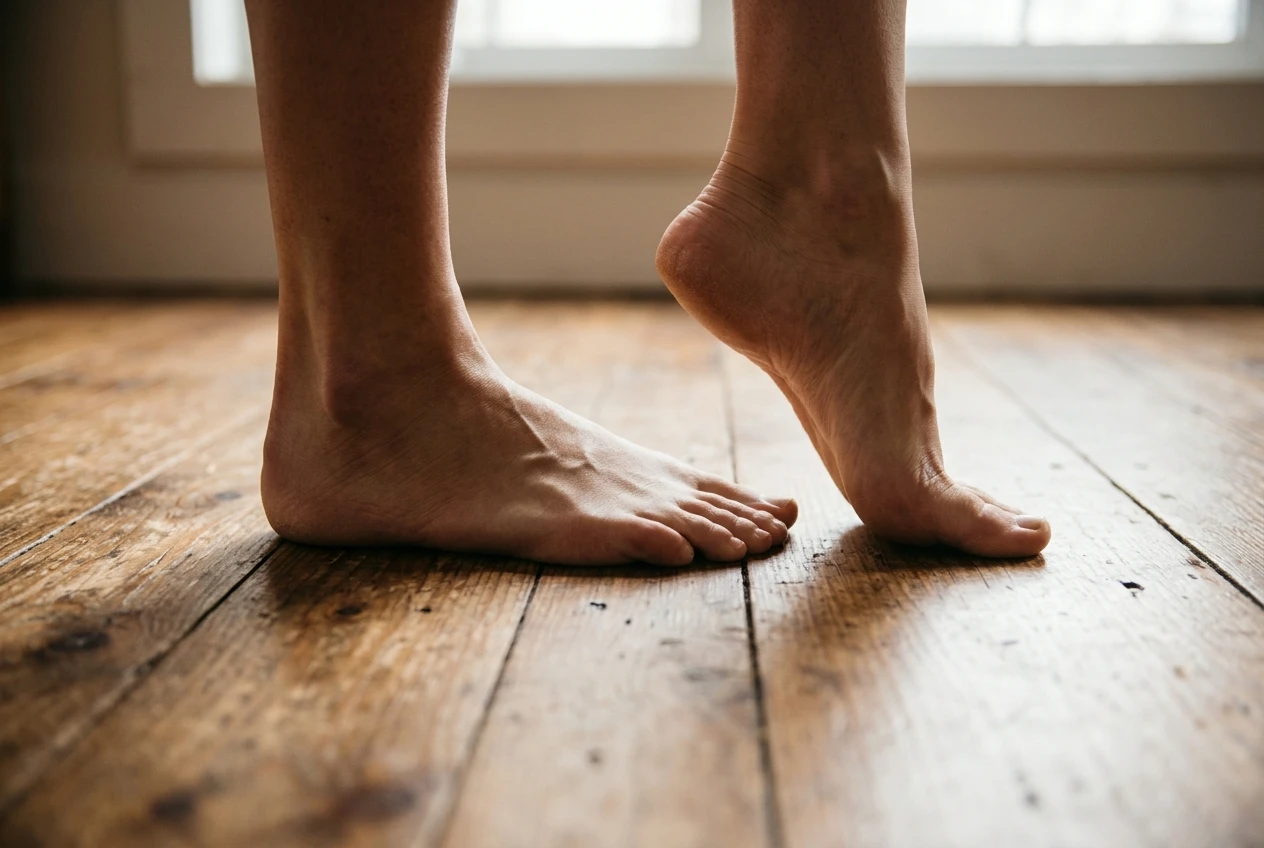
Taiji describes the unweighted leg as “empty”. It is not clenched, planted or braced. It rests lightly and waits. To make that possible, the supporting leg has to carry the whole body, which means the standing foot, ankle, knee and hip all work together. You can build up to this: keep the empty foot on the floor at first with the toes just touching, and lift it only when the support leg feels settled.
A quiet centre
Your centre is roughly the area around your lower belly and pelvis. In practice, “quiet” means the upper body is not lurching to compensate. If your shoulders swing over to one side whenever you shift, the base has not been properly established. A small, still torso is a sign that the legs are doing the job.
Together these are a form of repeated, low-stakes balance practice, and none of it requires you to touch your toes.
What research says about Taiji and balance, and what it cannot promise
The research is encouraging but has limits, and it is worth knowing both.
The Cochrane review of exercise for preventing falls in older people living in the community (Sherrington and colleagues, 2019) is one of the most cited summaries. It concluded that exercise programmes can reduce falls, and that Taiji may reduce the rate of falls and the number of people who fall. The authors rated their certainty about the Taiji finding as low, in part because trials differ in style, teaching and how long people practised.
Smaller trials have tested Taiji against other forms of exercise. A randomised trial in the New England Journal of Medicine (Li and colleagues, 2012) studied people with Parkinson’s disease and found that those in a Taiji group did better on measures of postural stability than those doing stretching, and in some measures better than those doing resistance training. That is a specific group, and the result should not be stretched to everyone.
Here is what the research cannot tell you:
- It cannot promise that Taiji will prevent a fall for you personally.
- It does not show that a home beginner following a video gets the same effect as someone in a supervised class, since most trials used trained instructors.
- It does not settle which style, stance depth or amount of practice works best.
- It does not replace advice from a doctor or physiotherapist if you have had falls, dizziness, or a joint condition that needs management.
The reasonable summary is that Taiji is a sensible, low-impact way to practise balance, and there is respectable evidence that it helps. That is a different claim from a guarantee. If you are worried about falling, mention it to your doctor and consider learning with a teacher. Six signs your home Taiji practice is ready for a live teacher can help you judge when that makes sense.
Three signs you are chasing range instead of stability
Most stiff beginners fall into the same few habits, because we are used to measuring ourselves by how far we can go. Here are three signs it is happening, and what to do about each.
1. Your knees or hips complain afterwards. An ache that appears during practice or the next morning often means the stance was deeper or wider than your joints could manage. Raise your stance, shorten your step and see whether the discomfort eases. If it persists, check in with a professional, and the three questions in push or rest? can help you decide how much to do on a given day.
2. You wobble or grab at the moment of the step. If you only feel unsteady when you reach for a long step, the step is longer than your balance can currently control. Shorten it until the shift feels smooth. Keep the toe of the empty foot on the floor, and lengthen only when you can hold the shift without correcting.
3. Your upper body swings to make the shape. Leaning, hip-hiking or shoulders dipping to one side is a way of borrowing range you do not have. Reduce the movement until the torso stays level over the supporting leg. A small, upright, steady movement is a better version of the form than a larger, lurching one.
In each case, the fix is the same: make the movement smaller until it is controlled, and then let range grow on its own if it is going to. It often does, slowly, but it is a side effect and not the aim.
A one-minute weight-shift check to try beside a counter
You need a kitchen counter or a sturdy chair back, a clear patch of floor and about a minute. If you are dizzy, have recently fallen or have been told to avoid standing exercises, check with your doctor first.

- Stand beside the counter with one hand resting lightly on it. Feet are about hip-width apart, knees slightly soft.
- Let your breath settle for a few seconds.
- Slowly move your weight onto your right foot. Go only as far as the movement feels steady, and keep the left foot on the floor, toes resting.
- Pause and notice whether your head and ribs stay over the right foot, or whether you lean away.
- Slowly return to the middle, then shift to the left foot in the same way.
- Repeat, slowly, for about a minute. Do not lift the other foot high. A small, quiet shift is enough.
Afterwards, jot down what you noticed: which side felt steadier, whether your hand pressed on the counter, and whether any joint complained. Doing this over a week or two gives you a record of your own starting point.
When you are ready to read more, five books for a small Taiji and Qigong shelf is a gentle place to start.