
If you sit for most of the day, your hips, lower back and knees tend to complain first. Shoulder tension gets most of the attention, and we have a separate piece on that, so this one starts lower down. Qigong for sitting all day can be built around five parts of the body in a fixed order: breath, pelvis, spine, legs, wrists. Each takes about a minute, and you can do all of them without leaving your chair.
What long sitting does to a body, and what Qigong can honestly offer
The World Health Organization’s 2020 guidelines on physical activity and sedentary behaviour advise adults to limit the time they spend sitting. They also say that replacing sedentary time with physical activity of any intensity, including light activity, brings benefit. The same guidelines recommend at least 150 to 300 minutes of moderate-intensity aerobic activity a week for adults, plus muscle-strengthening work on two or more days.
Qigong in a chair does not meet those targets, and it does not replace standing up and walking. Think of it as a way to interrupt a long stretch of stillness so your breathing, pelvis and legs keep moving between the times you do stand. Many people find that gentle, slow movement also makes them more aware of when they have been holding one position too long, which makes it easier to get up.
Qigong does not treat or cure any condition. If you have a diagnosed hip, back or circulation problem, these movements are an addition to your care and not a substitute for it.
Set up the chair first: feet, sitting bones and a spine that is stacked, not stiff
Most of the benefit of the later movements depends on where you start from. A few adjustments take under a minute.
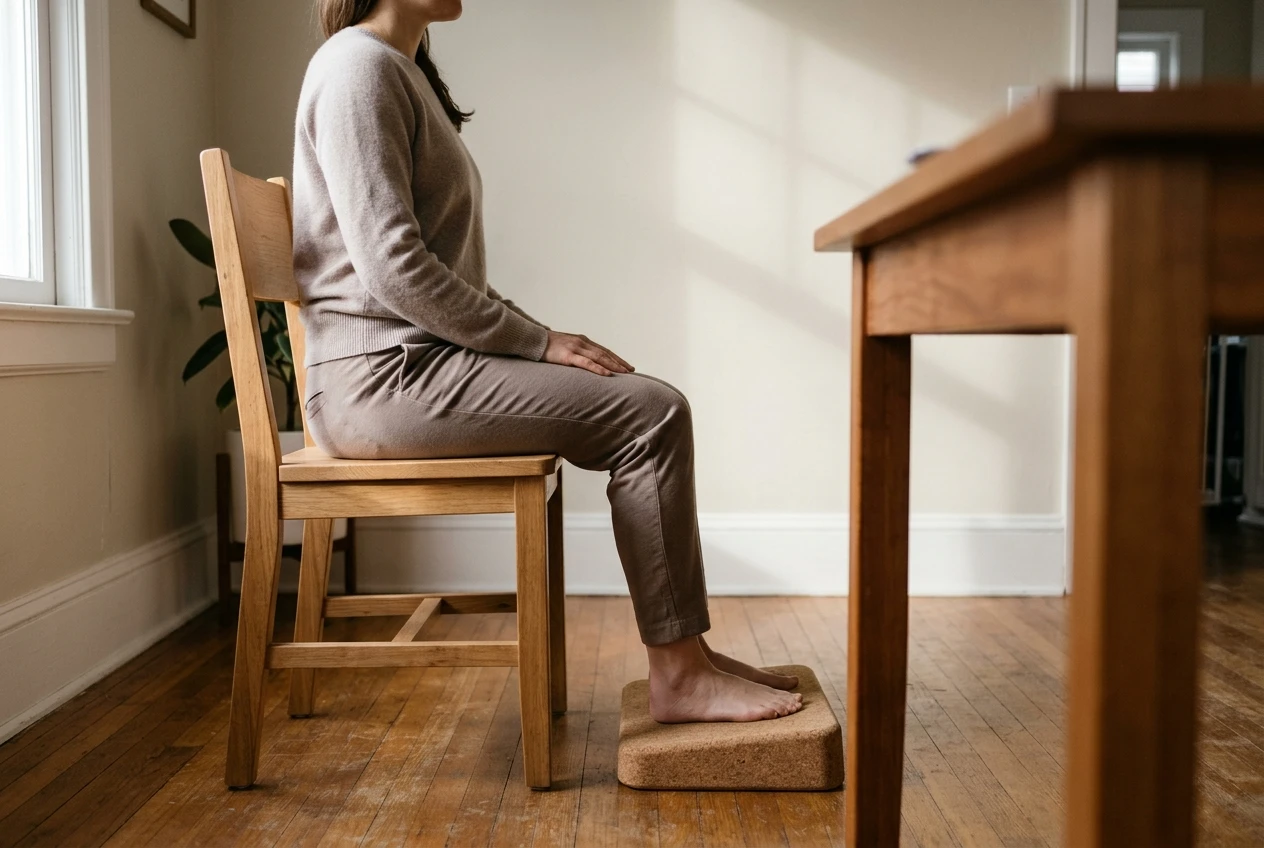
- Feet flat on the floor. Hips and knees should be roughly level, or the knees slightly lower than the hips. If your feet dangle, put a box or a firm cushion under them.
- Sitting bones under you. Feel the two bony points in your buttocks pressing into the seat. Your weight should rest on them, not on your tailbone behind them or the backs of your thighs in front.
- Spine stacked. Imagine the head resting lightly on top of the neck, the neck on the ribcage, and the ribcage on the pelvis. Stacked is different from stiff: you are not pulling your chest up or pinning your shoulders back.
- Back away from the backrest. Sit a few centimetres forward so the spine holds itself up for the length of each practice. You can lean back afterwards.
Taiji and Qigong teachers often describe the same posture as sinking while staying upright. If you want to feel that in a standing position, the piece on why Taiji asks your hips and shoulders to open together covers it.
The three-breath reset: slow belly breathing you can do mid-email
Start every round with breath, because everything after it goes better when the ribs and belly are moving.

Rest one hand on your lower belly, just below the navel, and let the other hand lie in your lap. Close your eyes if that is comfortable, or soften your gaze on a spot on the desk.
- Breathe in slowly through your nose and let the lower belly expand into your hand. Do not force it. The ribs widen a little to the sides as well.
- Breathe out through your nose, or through slightly parted lips, a little more slowly than you breathed in. Feel the belly settle back toward the spine.
- Repeat for three full breaths. Let the pause at the bottom of each exhale be as long as feels natural.
Many people hold their breath or breathe high in the chest when they concentrate on a screen. Three slower breaths bring attention back to the body, and the lower belly is a useful place to feel it because it is easy to notice when it has stopped moving. If you get dizzy, return to normal breathing and make the next attempt smaller.
Our piece on six small energy leaks in an ordinary day has other one-minute resets if you want variety on a hard afternoon.
Rocking the pelvis and rolling the spine to wake up a sitting back
After a long sit, the pelvis and lower spine tend to freeze in one position. These two movements ask them to move gently through a small range.
Pelvic rocking
Sit on the front half of the chair with your hands resting on your thighs. As you breathe in, tilt the top of your pelvis forward so your lower back curves slightly and your belly softens forward. As you breathe out, tilt it back so your lower back rounds gently and your tailbone tucks a little under you.
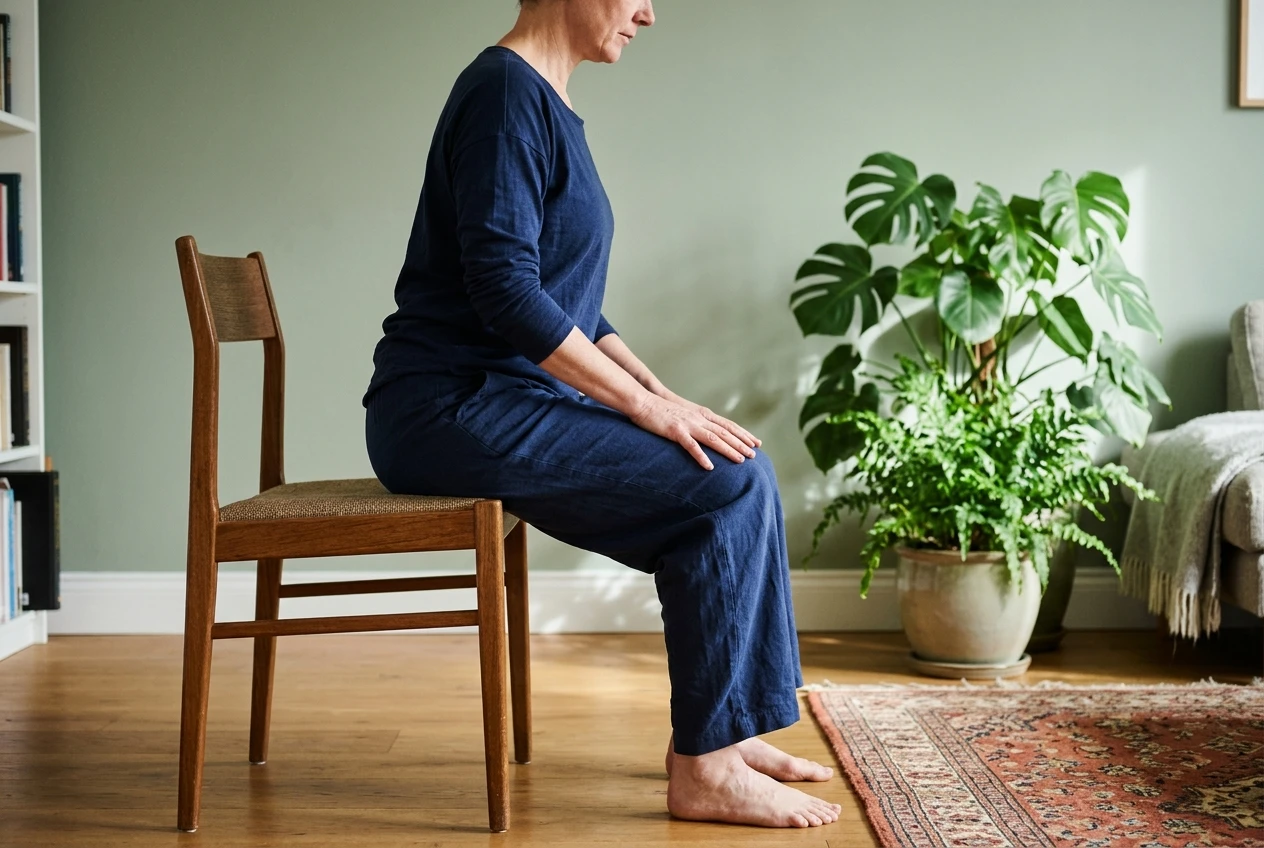
Keep the movement small, like rocking on the sitting bones. Repeat six to eight times, matching the breath. If a range of movement hurts, make it smaller or stop.
Spinal wave
Starting from the same position, let the rocking travel up the spine. On the exhale, round your lower back, then your middle back, then let the head drop forward last. On the inhale, reverse it: the lower back lengthens first, then the chest opens a little, and the head floats back to the top of the stack.
Do this three or four times. It should feel like unrolling something slowly. Keep the shoulders loose so they do not do the work. A rounded, gentle roll is enough, and you do not need to fold deep over your knees.
Ankles, knees and hips: keeping the legs from going to sleep under the desk
Legs that stay bent and still for hours often feel heavy, stiff or tingly when you finally stand. Small, slow movements keep some circulation of effort going through them. You can do these under a desk where nobody sees.
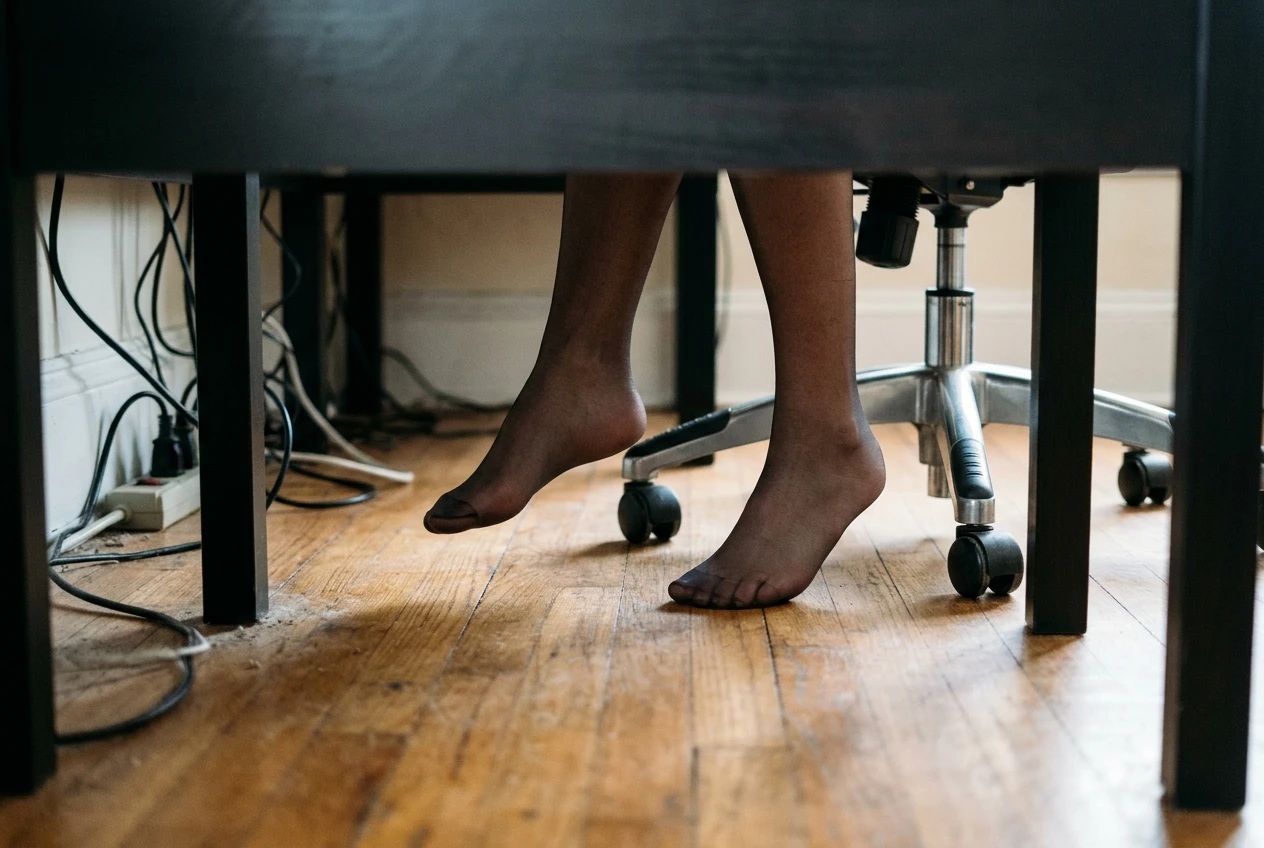
- Ankle circles. Lift one foot a little and draw slow circles with the toes, five in each direction, then swap feet. Imagine drawing a circle on the floor with your big toe.
- Heel and toe lifts. With both feet flat, lift the heels while the toes stay down, then lower and lift the toes while the heels stay down. Do six rounds at a gentle pace.
- Knee floats. Hold the seat edge lightly and slowly lift one knee a few centimetres, then lower it. Alternate for six lifts a side. Keep the movement smooth and stop if you feel a pinch in the knee.
- Hip opening. Let your knees drift apart a comfortable distance as you breathe in, and let them settle back as you breathe out. Go only as wide as your hips allow without strain.
If your knees are sore, the same gentleness applies on your feet; our piece on five small adjustments that make Taiji kinder on sore knees explains how to adapt standing movements, and the principle of staying well inside your range carries over to the chair.
Wrists, hands and eyes: quiet micro-movements for screen work
Keyboard and mouse work keeps the wrists and fingers in a narrow range for hours, while the eyes stay locked on one distance. The movements here are small enough to do while a document loads.
Wrist circles. Rest your forearms on the desk or your thighs. Make slow circles with the hands, five each way. Let the fingers stay soft so the movement comes from the wrist.
Open and close. Make a loose fist as you breathe out, then open the hands and spread the fingers as you breathe in. Repeat six times. Shake the hands out afterwards.
Palming for the eyes. Rub your palms together until they feel warm, then cup them lightly over your closed eyes without pressing on the eyeballs. Rest there for three breaths. The warmth and darkness give your eyes a rest from the screen.
Far gaze. Look up from the screen at something as far away as you can see, such as a tree through a window or the end of the room. Let your gaze rest there for a few breaths. This is a rest for your eyes, and it is also a prompt to check whether your jaw and shoulders have crept up.
If you notice numbness, tingling or pain in the hands that comes and goes with computer work, speak to a doctor or physiotherapist and do not rely on exercises alone.
Hanging the day on anchors: when to practise, and when to simply stand up
A rhythm is easier to keep when it is tied to something you already do. These are everyday anchors that work well:
- Finishing a call or a meeting
- Sending an email you have been putting off
- Pouring a drink or making a cup of tea
- Hearing the hour chime on a clock or a phone
You do not need to do the full sequence each time. One round is breath, then pelvis, then spine, then legs, then wrists, and takes about five minutes if you do every movement. On a busy day, choose one part of the body and do only that. A single minute at several anchors adds up more reliably than one long session you skip.
Standing up counts for more than any seated movement. Whenever you can, finish a round by standing, walking to another room, refilling your water, or stepping outside for a short walk. The WHO guidance talks about breaking up sedentary time with activity, and walking does that better than any exercise performed in a chair.
If you are unsure whether to practise on a given day, for instance when you feel unusually tired or sore, the piece on three questions to ask your body before you practise will help you decide.
What to expect after two weeks, and when to see a professional
After a couple of weeks of doing a few rounds a day, many people notice small things: they catch themselves holding their breath sooner, they sit up from a slump with less effort, or their legs feel a little less heavy at the end of the afternoon. These are modest changes, and not everyone notices them. They are also not guaranteed, because this is a gentle practice and not a treatment.
A short note each evening makes any change easier to see. Write one line about how your hips, back and breathing felt at the end of the working day. After two weeks, read it back. If nothing has changed, try adding one more anchor or standing up more often before you decide the practice is not useful.
See a doctor or physiotherapist if you have:
- Pain that wakes you at night or does not ease with changes of position
- Numbness, tingling or weakness in your legs or hands
- Swelling, redness or warmth in a calf or joint, or sudden shortness of breath
- Pain that gets worse when you do these movements
Do not wait for the two-week mark if any of those apply.
One thing to try
Pick one regular anchor in your day, such as the moment you finish a call or pour a drink. At that moment, put your feet flat on the floor and take three slow breaths into your lower belly. Afterwards, notice how your seat and shoulders feel, and jot it down.