

Many people with stiff joints can name the week autumn arrives. The mornings get cooler, the air turns damp, and the knees, hands or hips start complaining as soon as you get out of bed. It is a very common experience, and it is reasonable to ask whether it is the weather itself or something else that changes at the same time.
This article looks at what research says on the question does weather affect joint pain, which is less settled than most articles suggest. It also gives you a two-week notebook to find out what happens in your own body, and a short Qigong sequence for the mornings when you feel stiff.
Why so many of us feel it the week the weather turns
A change in season rarely arrives alone. Temperature falls, daylight shortens, the air holds more moisture, and our habits shift too: we wear more layers, walk less, sit more and sleep at different times. Any of these could be the cause, and several could act together.
Stiffness is also easiest to notice at the moments that already invite it. After hours of lying still, joints feel less willing to move. In a cold bedroom, muscles tighten a little against the chill, and the first steps of the day feel slower. On a bright warm morning you may never register the same stiffness, because you are not looking for it.
So the feeling is real, and the cause is a separate question. The research below takes up that question.
What the research actually says about pressure, cold and damp
Studies on weather and joint pain do not agree, and the differences come partly from who was studied and how pain was measured.
Large surveys show that many people believe in a link. The EPOSA study (European Project on OSteoArthritis), written up by Timmermans and colleagues in BMC Musculoskeletal Disorders in 2015, asked older adults with osteoarthritis in six European countries whether they were sensitive to weather. Many said they were. That tells us what people experience, but it is a self-report. It does not show that the weather caused the pain.
Some studies that measured both pain and weather found a modest link. McAlindon and colleagues, in the American Journal of Medicine in 2007, followed people with knee osteoarthritis and found that pain tended to be higher when temperatures were lower and when barometric pressure changed. The sample and setting were specific, so the result may not apply to everyone.
The largest tracking study found small effects. The UK’s Cloudy with a Chance of Pain project, reported by Dixon and colleagues in npj Digital Medicine in 2019, had thousands of people with long-term pain record their symptoms in a phone app over many months. Their reports were matched to local weather data. Pain was somewhat more likely on days with high humidity, low pressure and stronger wind. Temperature on its own did not stand out, and the effects were small. People also differed from one another a great deal, so some were clearly weather-sensitive and many were not.
Back pain looks different. Steffens and colleagues, in Arthritis Care & Research in 2014, studied people with new episodes of low back pain and compared the weather at the time of onset with weather on control days. They did not find a clear link between most weather measures and back pain onset. This applies to a different condition from joint osteoarthritis, but it is a reminder that “weather and pain” is not one question with one answer.
Putting these together, we can say that:
- Some people seem to be sensitive to weather, and for them damp, low pressure or cold may matter.
- The average effect across large groups is small.
- No one has shown a mechanism that explains it, so the cause remains uncertain.
- Individual differences are large, which is why your own record is worth more than a general claim.
If you want the details, the original papers are free to search by title and year.
Other things that change in autumn and may be doing the stiffening
Weather may be part of the picture, but several other autumn changes can also make joints feel worse. Each of these is a possibility rather than a finding:

- Less movement. Shorter days and cooler air can mean fewer walks and more time sitting. Joints that move less tend to feel stiffer.
- Cold muscles. Tense, chilled muscles around a joint can add to the sense of tightness, particularly in the first hour after waking.
- Sleep changes. Poorer or shorter sleep tends to make aches more noticeable. A restless night can look like a weather effect.
- Mood and light. Lower mood and less daylight can change how we perceive pain.
- Routine changes. A return to desk work, more driving, or a new schedule after summer can load the joints differently.
None of these cancels out the weather explanation, and they can all happen at once. Your notebook, described below, helps sort them out.
How Taiji and Qigong traditions describe seasonal change, and where that is metaphor
In the traditional Chinese medical framework that Qigong and food energetics draw on, autumn is the season of gathering and drawing inward, after summer’s outward expansion. The classic text Huangdi Neijing also describes painful obstruction, called bi, which it links to wind, cold and damp settling in the body. Many practitioners use this language to explain why joints complain in cold, wet weather.
This is a way of describing experience, and it is not evidence from clinical trials. It is a framework with its own logic, handed down over a very long time, and it can shape how a practice is chosen: more warmth, gentler pacing, more attention to the body’s signals in autumn. It cannot tell you why your own knee aches, and it should not be read as a diagnosis or a promise.
The useful part is the attitude it encourages: notice the season, adjust gently, and avoid forcing the body to behave as it did in July. That attitude fits well with the notebook below.
A two-week joint and weather notebook
Two weeks is long enough to see a rough pattern and short enough to keep going. Write one short entry each morning, with these four things:

- The weather. Note the temperature, whether the air feels damp or dry, and whether it is rainy, windy or clear. If you check a weather app, add the pressure reading and whether it is rising or falling.
- How your joints felt on waking. Give each stiff area a score from 0 to 10, and note roughly how many minutes it took to loosen up.
- Yesterday in brief. Write down how much you moved, how well you slept, and anything unusual, such as a long drive or heavy gardening.
- What you did, and what happened. Record a warm drink, a warm-up, a Qigong session or a rest, and whether it seemed to help.
Keep each entry to a few lines. If you want ideas for what else to note over time, the piece on what to write in a Taiji and Qigong practice journal goes into that in more detail.
After two weeks, read the pages together. You may see that the worst mornings follow poor sleep, or that stiffness tracks damp days, or that no pattern appears at all. Each of those results is useful, and each is more reliable than a guess.
A five-minute Qigong warm-up for a stiff morning
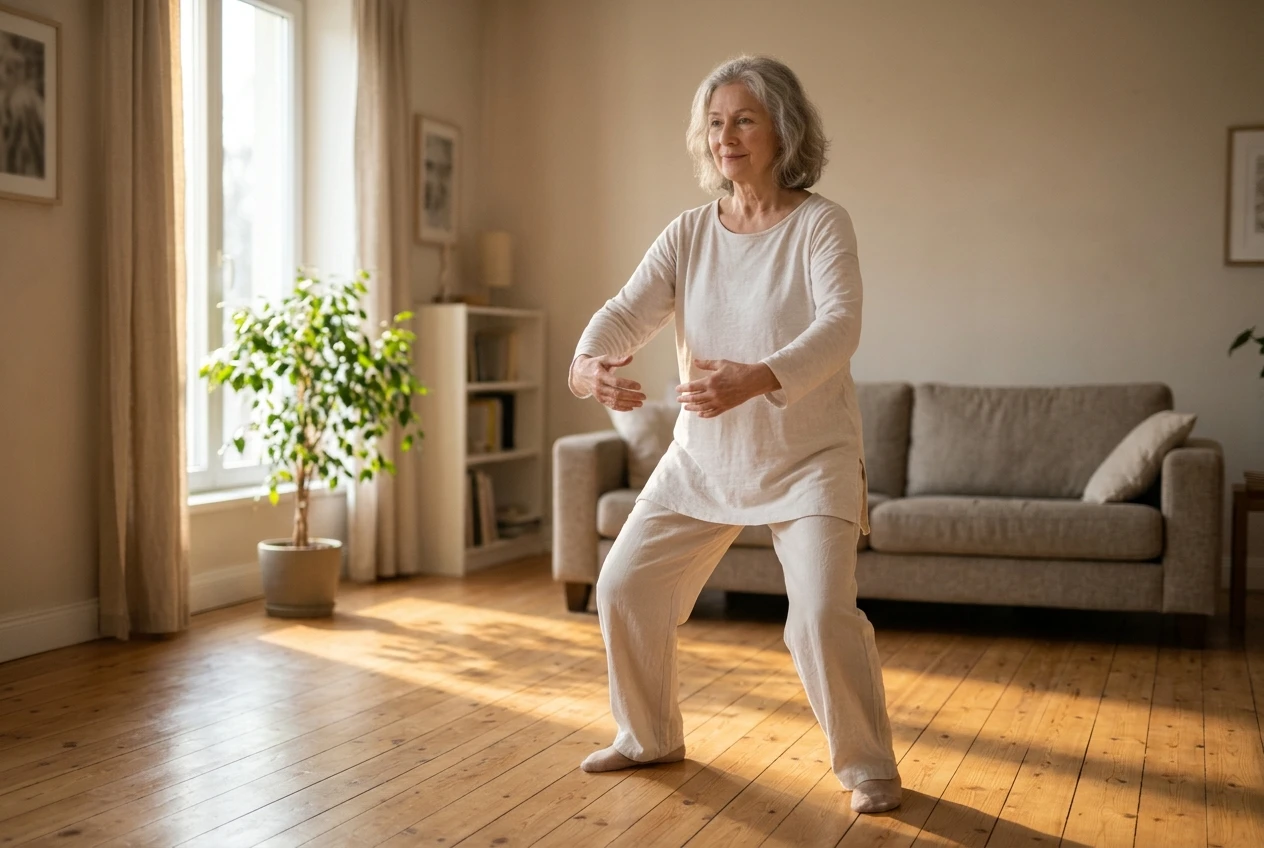
Do this standing with your feet about hip-width apart, or sitting on a firm chair if standing is uncomfortable. Move slowly and stay within a comfortable range. Stop any movement that causes sharp or increasing pain. This sequence is a gentle way to warm up, and it is not a treatment.
Minute one: warm the hands and breathe. Rub your palms together until they feel warm. Rest them on your lower belly and breathe in and out through your nose. Let the exhale be a little longer than the inhale.
Minute two: small joint circles. Roll your wrists slowly in each direction, then your ankles, one at a time. Make the circles small and smooth.
Minute three: shoulders and spine. Roll your shoulders back, then forward, in slow circles. Then turn gently from side to side from the waist, letting your arms swing loosely. Keep your knees soft.
Minute four: knee sways. Bend your knees slightly and shift your weight from one foot to the other, as if rocking a boat gently. Keep your knees pointing in the same direction as your toes, and bend only as far as is comfortable.
Minute five: open, close, settle. Raise your arms in front of you as though holding a large soft ball, then slowly open them to the sides as you inhale. Bring them back and lower your hands to your belly as you exhale. Repeat a few times, then stand still for a few breaths.
Afterward, add a line to your notebook about how your joints felt.
Warming food and rest as quiet support
Warm meals and enough rest are modest ways to look after yourself during the colder months, and neither is a cure. Cooked food and warm drinks are comforting on a chilly morning. For a practical approach, see a simple way to build a warming winter plate, which lays out how to put a warming meal together when your joints feel the cold.
Rest matters in the same way. If your notebook shows that poor sleep or a very busy day tends to come before a stiff morning, rest may deserve a bigger place in your week. The article on why rest is part of your Qigong practice explains how to treat rest as part of the routine instead of a lapse in it.
When stiffness deserves a conversation with your doctor
A notebook is a tool for noticing patterns, and it does not replace medical advice. Please speak to a doctor if you notice any of the following:
- A joint that is swollen, hot or red
- Stiffness that lasts a long time after waking, or that keeps getting worse
- Pain that comes on suddenly or follows an injury
- Pain that wakes you at night or is present at rest
- Numbness, tingling or weakness
- Fever or feeling generally unwell along with joint pain
- Difficulty using a joint for everyday tasks
If you do see a doctor, bring your notebook. Entries on timing, severity and what seemed to help give them clearer information than memory can.
One thing to try
Tonight, write down one line: today’s weather, how your joints felt on waking, and what you did. Keep it up for two weeks and see what your own pattern says.